

A LinkedIn newsletter can be one of the most reliable ways to get in front of the same people again and again. But plenty of people publish one for months and get lots of reads and no enquiries. This article shows you why that happens, and the exact steps to build a LinkedIn newsletter that generates leads rather than passive browsers.
We’ll go through…
- Why a LinkedIn newsletter is worth doing
- Why most newsletters don’t bring leads
- How to grow subscribers who are buyers
- How to structure every edition
- How to teach through your own method
- How to start conversations while the newsletter builds
- How to get your newsletter cited in AI search
So, let’s get into it.
Step 1: Why build a LinkedIn newsletter that generates leads
Long-form content tends to convert at a higher rate than short posts and leaves a deeper, more lasting impression, a pattern consistently backed by LinkedIn Marketing Solutions research on B2B content engagement, which shows decision-makers spend far more time with substantive, native thought leadership than fleeting feed updates.
LinkedIn also gives newsletters special treatment:
1. Subscribers are notified: When you publish an edition, LinkedIn pushes it to your subscribers by notification and email. With a normal post you never know who will see it.
2. LinkedIn invites people for you: When you launch, it invites your followers and connections to subscribe, then invites each new connection and follower after that.
3. It’s cited more: Newsletter articles are found more often in LinkedIn search and cited more often in AI answers.
That matters because people usually need to see you many times before they reach out. A post is erratic. A newsletter puts you in front of the same people repeatedly, which builds the multiple exposures that lead to inbound enquiries.
For more on how this fits into a bigger system, read how to get leads on LinkedIn.
Step 2: Avoid the four mistakes that stop a LinkedIn newsletter that generates leads
1. The title isn’t linked to what buyers want
People subscribe for what they want. A title that describes you, or just names a topic, gives them no reason to sign up.
Dean once told a client to delete their newsletter. It was called something like “Executive Coaching Insights” and was aimed at CEOs. It attracted other coaches and people with a passing interest, not buyers. Buyers don’t care about executive coaching. They care about what it gets them.
Name your newsletter after what your reader wants to gain, not what you do.
2. Your network doesn’t contain your ideal clients
LinkedIn invites your network based on your newsletter. If your connections aren’t your ideal clients, the wrong people see the invitation. Dean estimates that about half of a network changes job, changes industry, retires or leaves the workforce within 18 to 24 months, so keep building it with the right people.
3. The content isn’t linked to a buying motivation
Subject-matter experts often publish educational content that isn’t tied to why people buy. Lead with what the reader wants, then show them what they need through that lens. It doesn’t mean every edition is a pitch. It means the reason they read is the same reason they’d buy.
4. You’re relying on them to do all the work
Don’t hope readers will get in touch. Spell out how you help, and build a system around it (steps below).
What if your title is wrong?
You have two options, and neither is great: delete the newsletter, or create a second one. If you keep both, you can’t be sure which one LinkedIn is promoting.
Changing the name doesn’t solve it, because LinkedIn only invites your whole network once, at launch. With a weak title, you might get 300 sign-ups from 10,000 connections. With the right one, it could be 800 or a thousand. If you delete it, take the articles down and refresh them or republish them on your website.
Step 3: Grow subscribers who are buyers
1. Grow your network with your ideal client, because LinkedIn invites them automatically.
2. Make the title and thumbnail promise a gain. Treat them a little like YouTube thumbnails: both should speak to something the reader wants. A boring or random image gets skipped.
3. Share editions in public groups where your ideal client spends time, with a short post. Niche groups can bring a lot of reach.
4. Share beyond LinkedIn: Facebook groups, X, Threads, Substack, Instagram stories, and your email list.
5. Consider a small boost: If an edition really lands and brings enquiries, you can promote it to your exact ideal client for as little as around $30. Only do it for editions that bring leads, not for vanity.
Step 4: Structure a LinkedIn newsletter that generates leads
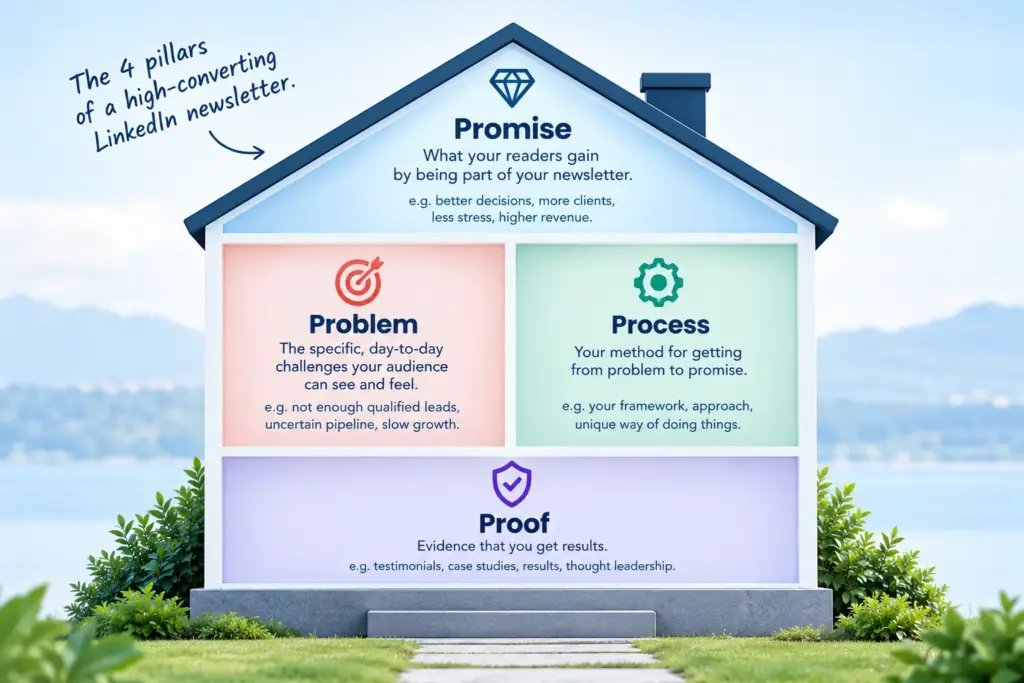
Dean uses content pillars to make sure each edition ties back to what you sell. Where it fits, include:
1. The promise: What people gain from being around you.
2. The problem: The specific, day-to-day problems your buyers can see and feel, not abstract ideas.
3. The proof: Stories and experiences around these issues.
4. The process: Advice shared through the lens of your method (see Step 5).
5. Tension: The gap between the problem they live with and the outcome they want. This is called creating internal urgency. It isn’t pressure. It’s helping people see the gap, so it needs a specific audience, because what agitates a CEO differs from what agitates a solo founder.
6. A clear call to action: In every edition, add a short “how I help” section with a way to book a call.
7. An anchor lead magnet: Have a few reusable resources, one per topic, such as a checklist or template, so readers can take a next step and you can follow up.
Link to your offer
If people can’t see what they can buy, they find it harder to consider. Link to a brochure or a page on your website so enquiries come in already knowing what you do, and the call is about questions, not “what is it you do?”
How is a newsletter different from a post?
A post is shorter and you never know who will see it. A newsletter is longer, and many of the people who see it will be the same people each time, so you build a multi-touch approach. It’s closer to authority-building than a one-off post.
Step 5: Teach through the lens of your method
This is the part most people skip. Everyone has a process for how they work with clients. When you share ideas through your method, rather than as generic tips, people start to buy into your way of solving the problem, and that’s something they can only get from you.
Dean’s method is the signal framework, which has three parts: Proposition, Pre-sell and Pipeline. If he wrote an article on why content isn’t converting, he’d give practical tips, then weave in the idea that the audience may be too broad for anyone to resonate, and share an example of how a narrower proposition changed a client’s results.
Tips for a method people buy into
1. Keep it simple: Three to five steps, not 27. You can go deeper in a later edition.
2. Name it: A named framework is easier to remember and repeat.
3. Show the structure: The promise is the roof, the problem is the foundation, your process is the supports, and your proof is the certificate that it’s well built. Many people have lots of testimonials and no process, so readers think “I can see you’ve done it, but I’m not sure how it’ll work for me.”
Also, people need to see you around ten times before they’re primed to buy, so keep your message consistent across your profile, posts and newsletter. For more on this, read how to sell your expertise on LinkedIn.
Step 6: Turn subscribers into a LinkedIn newsletter that generates leads
The first 90 days on LinkedIn can feel like a slog, and people who don’t get an early win often lose interest. So pair your newsletter with what Dean calls reactive outbound: talking to people who have already shown interest.
When someone subscribes, engages, shares or looks at your profile, send a short, friendly message. Don’t pitch. Thank them, mention what the newsletter helps with, and ask if it’s something they’re working on.
Thanks for subscribing. The newsletter is aimed at helping people get leads on LinkedIn. Is that something you’re looking at at the moment?
You’re simply following their interest. Doing this stops you posting and posting and building resentment while you wait for enquiries to arrive.
Step 7: Get cited in AI and Google search
More people are asking AI tools and search engines how to solve their problems, and these tools draw heavily on LinkedIn content. Newsletter articles in particular are cited a lot.
1. Say who you are and what you’ve done: What you say about yourself is what AI will tell other people. Keep a list of facts about your experience, results and clients, and weave one or two into each article naturally.
2. Name your methods: If you want AI to quote your framework, it needs a name and an explanation of why it works.
3. Be specific: Generalists cover too much ground, and AI doesn’t know what to do with them. Decide what you want to be known for and work backwards.
4. Repurpose: Turn the same article into a video, a website version and a short list post, reinforcing the same messages.
The goal is two-fold. On LinkedIn, the newsletter should get you conversations and leads. In search, it builds your reputation, so people searching for answers find you.
Your checklist for a LinkedIn newsletter that generates leads
1. Title: Names what the reader gains.
2. Network: Full of your ideal clients.
3. Content: Led by a buying motivation.
4. Method: Advice shared through your named process.
5. Call to action: A “how I help” section in every edition.
6. Follow-up: Reactive outbound to subscribers and engagers.
7. Visibility: Your story and frameworks named for AI search.
Want to go deeper? Explore our Content Creation Training or take a look at our free resources.
Keep reading: LinkedIn Content That Drives Sales: 7 Questions to Ask Before You Post
If you’d like help planning your newsletter, book a call and we’ll help you map out a 90-day plan.