

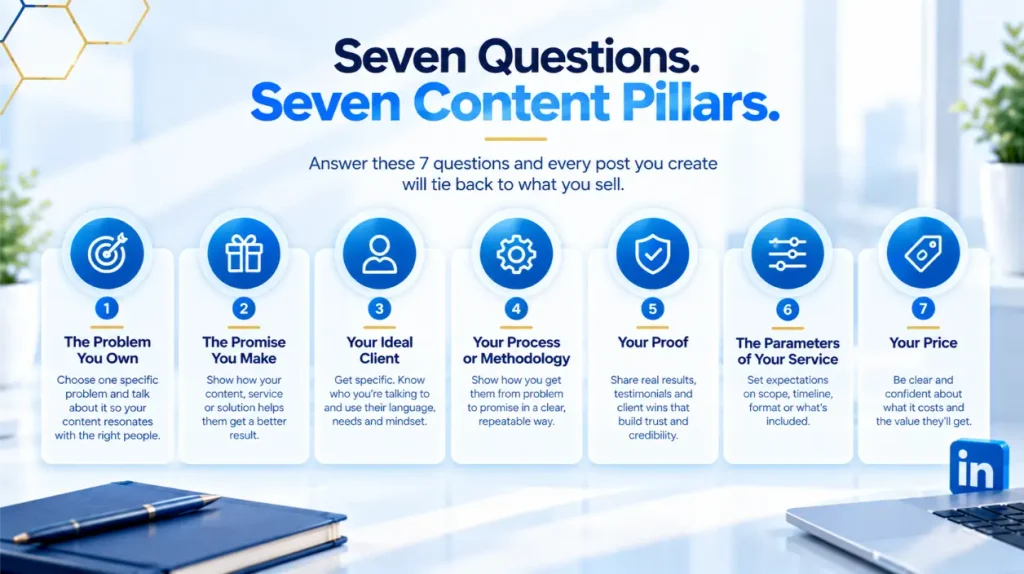
Most LinkedIn advice tells you to grow, grow, grow, and the leads will follow. For most people, that doesn’t work. I’ve done the opposite of what content creators and influencers do. I don’t chase virality. I focus on resonating with a highly targeted audience, and that approach has brought me leads, clients and a lot of revenue. This article breaks down the seven questions I ask so that I publish LinkedIn content that drives sales, rather than just vanity likes and superficial engagement.
We’ll go through…
The problem you’ll own
- The promise you make
- Your ideal client
- Your process or methodology
- Your proof
- The parameters of your service
- Your price
- Why signal content beats vanity content
Each question becomes a content pillar. Rotate through them and everything you post ties back to what you sell.
So, let’s get into it.
Step 1: Own a problem with LinkedIn content that drives sales
The first question is: what problem do you solve that you’re going to own on the platform?
This isn’t about posting anything. It’s about choosing one very specific problem and talking about it so your content resonates with people who have it.
Specific matters. “They’ve got no time” is too general, because none of us has any time. Pick a problem your audience would recognise instantly as theirs.
This problem becomes your first content pillar. You answer questions, give advice, share helpful information and challenge misconceptions about it. That appeals to people who are problem aware: they know they have a problem, and they pay attention to someone who clearly owns it. It also helps the algorithm show your content to the right people.
Tips for owning a problem
1. Be specific: If your audience can’t say “that’s exactly my situation”, it’s too general.
2. Answer real questions: Talk about what people in this situation are asking.
3. Challenge misconceptions: Show where common beliefs about the problem are wrong.
Step 2: Clarify your promise in LinkedIn content that drives sales
Next, ask: if people hang around you, consume your content or buy your service, how does their life specifically get better? How do their world and their business change?
Get tangible. Specificity is your best friend, because it’s how people start to feel the fit and see that what you do is relevant to them.
This is your second content pillar. People want a result, and when you name that result clearly, they pay attention. They want to know how to get it, what’s involved and what’s stopping them. Some people look at your profile and think, “I see what you do, but I don’t get why it matters to me.” The promise answers that.
Tips for owning a promise
1. Name the result: State the outcome in terms your buyer would use.
2. Tell the story behind it: Share why you do things the way you do and how you got to a result yourself.
3. Repeat it everywhere: Your content, your profile and everything you do should carry the same promise.
Step 3: Who exactly are you talking to?
Your third pillar is your ideal client profile. You can’t talk to everyone at once and resonate with anyone.
Not “business owners”, Not “employees”. Not even “people who work in tech”. It needs to be specific, because specificity gives you context.
Once you know who they are, and you connect that with the problem and the promise, you start to understand their world. You can think like them. You can use their words and phrases, describe how the problem feels and talk about their specific situations. They think, “This person really understands me.”
It also helps you answer the questions in their heads: what they might Google, and what they fear. I see this often with executive coaches. When you write what your ideal client is thinking, like a fly on the wall in their world, they say, “I see that too.”
When you weave problem, promise, and ideal client together, you create LinkedIn content that drives sales because buyers instantly recognize their specific business situation.
Tips for knowing your ideal client
1. Define them narrowly: Role, situation and context, not a broad category.
2. Use their language: Write the phrases they’d actually use.
3. Answer their questions: Cover what they’d search for and what worries them.
Step 4: Share methodology in LinkedIn content that drives sales
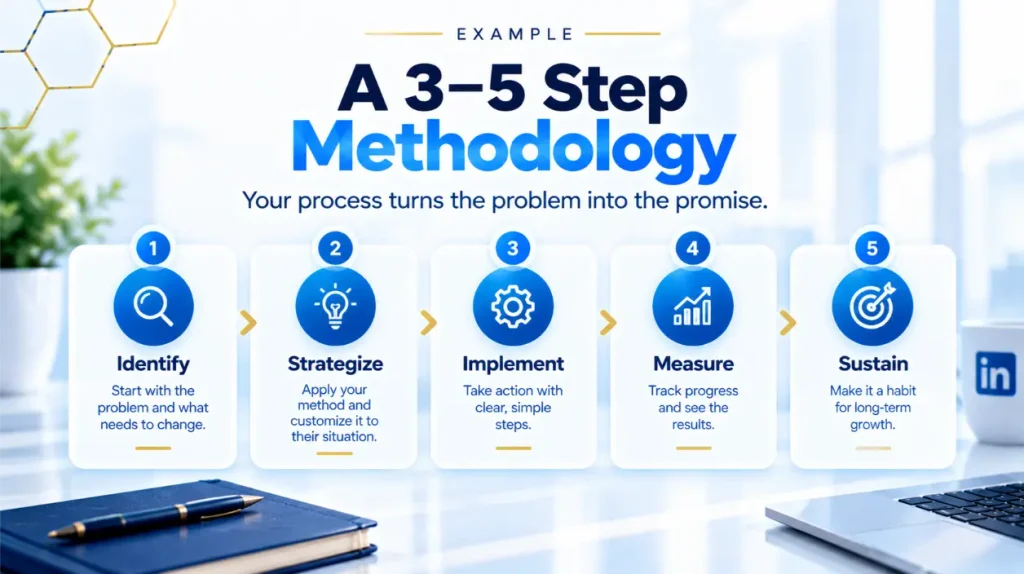
This is the most important pillar. Your methodology is how you get people from the problem to the promise.
When people see that your way of doing things can get them somewhere, they become interested in using your method. Your content should show why your method works for your ideal client: why it solves their problem and delivers the promise.
Take a situation they face and explain it through the lens of your three to five step process, showing how it fixes specific things in their world. It differentiates you from everyone else, because it gives people a way they can believe in and want to implement. It builds certainty and confidence, and desire for a model they can only get from you.
When people believe in your method, they can only get it from you.
Tips for sharing your process
1. Keep it to three to five steps: Simple enough to remember and repeat.
2. Apply it to real situations: Explain what’s happening in your ideal client’s world through your method.
3. Explain why it works: Not just what the steps are, but why they matter for this problem.
Step 5: What proof do you have?
Your fifth pillar is the evidence that backs up your promise and your method: case studies, testimonials, reviews and client wins.
Share your track record, but as stories, not marketing promos. Use screenshots, written testimonials and videos where you have them. What matters is the underlying proof that your method works and that you can get people to the promise.
I call the best examples wow posts. They’re a bit like a before and after: what the client was going through, the process you took them through and what happened afterwards. When these are relevant to your ideal client, they think, “You can do it for them, so you can do it for me.”
Tips for sharing proof
1. Tell the story: Before, process, after.
2. Match your audience: Choose wins that your ideal client will recognise as relevant.
3. Share regularly: Proof supports everything else you post.
The last two questions will feel counterintuitive, but they increase how seriously people consider buying from you.
Step 6: How does your service work?
People need to know how your service works, whether it’s one-to-one coaching, a piece of software or something else. These aren’t sexy posts. But they matter.
A common mistake in content and outreach is getting people interested before they know what they’re getting interested in. The more your ideal clients see exactly how you deliver, what you deliver and the success it brings, the more they warm to it.
This helps you avoid pitch shock: someone is interested, books a call, finally understands how your service works and ghosts you. It happens a lot on LinkedIn, when people post about their outcomes but never explain the service itself.
You don’t have to write “here’s how my service works”. Tell it through stories. For example: “Clients come to me because they want this, and over 12 coaching sessions, here’s what happens.” That makes people familiar with the delivery and what’s involved. It creates curiosity too, so they head to your profile to find out more.
Explaining how your service works prevents pitch shock on sales calls. According to McKinsey’s research on B2B buyer behavior, modern decision-makers expect clear, transparent information throughout their self-directed evaluation, meaning your content needs to clarify your delivery mechanics long before a discovery call takes place.
Tips for explaining your service
1. Use stories: Explain the mechanics through client examples, not a feature list.
2. Cover the scope: What’s included and how it’s delivered.
3. Avoid pitch shock: Leads should arrive knowing how your service works.
Step 7: What’s your price?
This is the most divisive of the seven, and it splits the internet: posting about your price.
I’m British, and we don’t like talking about money. It feels grubby and awkward. But talking about it works in your favour. It keeps you focused on who you really want to do business with, because your price is your positioning.
There’s a fear built into many of us that if we mention price, people will run a mile. What that really says is that we can’t get people to enquire at the price we charge, so we have to get them on a call and twist their arm. That’s not how it works.
One coach I worked with was nervous about posting her price in case it put people off. I told her price is positioning, and it filters. She put it out there and started getting more enquiries that actually converted. Some people hadn’t realised she was for them. Once the price was visible, they took her more seriously.
In any industry, there are people at the bottom, middle and top of the market. Don’t assume people know where you sit. People who want premium services dismiss lower-priced ones, and your branding alone can leave people unsure. A price tells them where you sit. More people get talked about for premium pricing than for being cheap.
Tips for talking about price
1. Treat it as positioning: Price signals where you sit in the market.
2. Explain why you charge it: People get curious about what justifies a premium.
3. Tell it as a story: Like the service itself, price lands better in a story than in a list.
Signal vs vanity: Creating LinkedIn content that drives sales
Now a promise, and you won’t like it. You won’t go viral with these posts. But they’ll make you more money than most influencers, because they attract the right people: those struggling with the problem, who want your promise and need a process to get there.
The mistake many people make, and I made it initially, is judging content by engagement. If you want buyers, you can’t sell to everybody, and content that appeals to everybody isn’t appealing to buyers. The message gets lost. This is about creating signal content, not vanity content.
One of my clients only posts around these seven questions. She doesn’t go viral, but she makes around a quarter of a million dollars a year from LinkedIn, because she has a strong high-ticket offer and builds all her content around it. When your content ties back to what you sell, and it resonates, you attract people who want what you have.
Checklist for LinkedIn content that drives sales
1. Problem: Which one specific problem will you own?
2. Promise: What tangible result do people get?
3. Ideal client: Who exactly are you talking to?
4. Process: What are your three to five steps, and why do they work?
5. Proof: Which case studies and wow posts back it up?
6. Service: How does it work, told through stories?
7. Price: Where do you sit in the market, and why?
Stop chasing virality. Start posting around these seven questions and you can make serious money on LinkedIn.
Want to go deeper? Explore our Content Creation Training and Thought Leadership Training, or take a look at our free resources.
Keep reading: How to Build a Profitable Personal Brand in 30 Days
If you want help building content that brings in leads, clients and revenue, book a call to learn how we can help.