

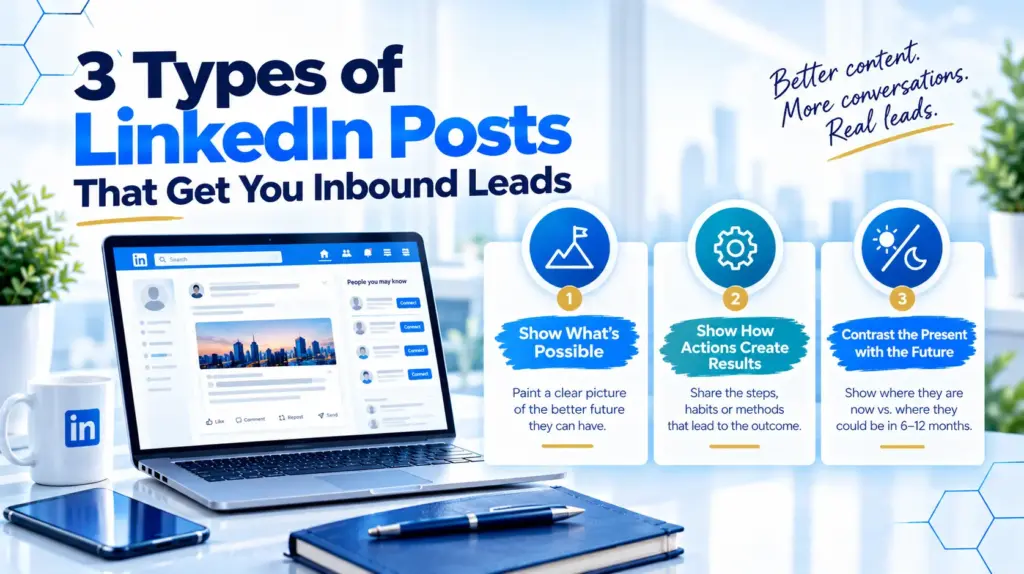
You’ve been told that educational content, personal content and thought leadership will bring you leads. You’ve probably tried all three, and you still don’t have a consistent flow of enquiries. There’s a reason for that. On their own, those types of content don’t create the one thing that makes people reach out. This article shows you what does, and walks you through three types of LinkedIn posts you can start sharing this week.
We’ll go through…
- What actually drives inbound leads
- Why talking to pain points backfires
- Post 1: Show what’s possible
- Post 2: Show how different actions create results
- Post 3: Contrast the present with the future
So, let’s get into it.
Step 1: Create tension between where they are and where they want to be
The secret to getting inbound leads is helping people feel that the goal they want is possible, while also reminding them of their current reality.
That’s the tension between how they’d like to run their business or live their life, and where they are now. Information alone doesn’t create it. It’s the gap that makes people think, “I need to do something about this.”
Step 2: Use aspirational framing, not pain points
This is the biggest mistake I see. We’re told to talk to the pain points. But when you do, your posts turn negative and blame-y, and nobody wants to be reminded that their baby is ugly.
You still need tension. You just create it with positive, aspirational framing: focus on where people could be, where they are now and where other people like them already are.
Tips for aspirational framing
- Lead with the destination: Start with what’s possible, then acknowledge the gap.
- Don’t blame: Show there’s a better way, not that their current way is wrong.
- Use people like them: Seeing others in their position get there makes it feel achievable.
Post 1: Types of LinkedIn posts that show what’s possible
Your first post type shows your ideal client what is actually possible if they solve this problem. They need to see it and feel it.
Describe what changes, both in your own life and in your clients’ lives, when the problem is solved. You can do this through:
- Case studies: What a client’s life or business looks like after.
- Your own journey: What changed for you.
- Breakdowns of situations: Different scenarios your audience will recognise.
The aim is to make the outcome real, so your audience can picture themselves there.
Post 2: Types of LinkedIn posts showing how actions create results
The second post type shows how different actions and behaviours create the results people want. You’re not saying what they do now is bad. You’re showing there’s a better way.
Show what good day-to-day working looks like: how successful people handle their daily actions, manage tasks or run their business. Your audience can compare that with how they work now, without you pointing a finger.
When they see that the result is connected to doing things differently, they start to realise they can’t keep doing things the way they are.
Tips for action-and-result posts
- Describe a good day: Make the routine or approach concrete.
- Link action to result: Show clearly what the change leads to.
- Let them draw the contrast: Show the better way and let your reader compare.
Post 3: Contrast the present with the future
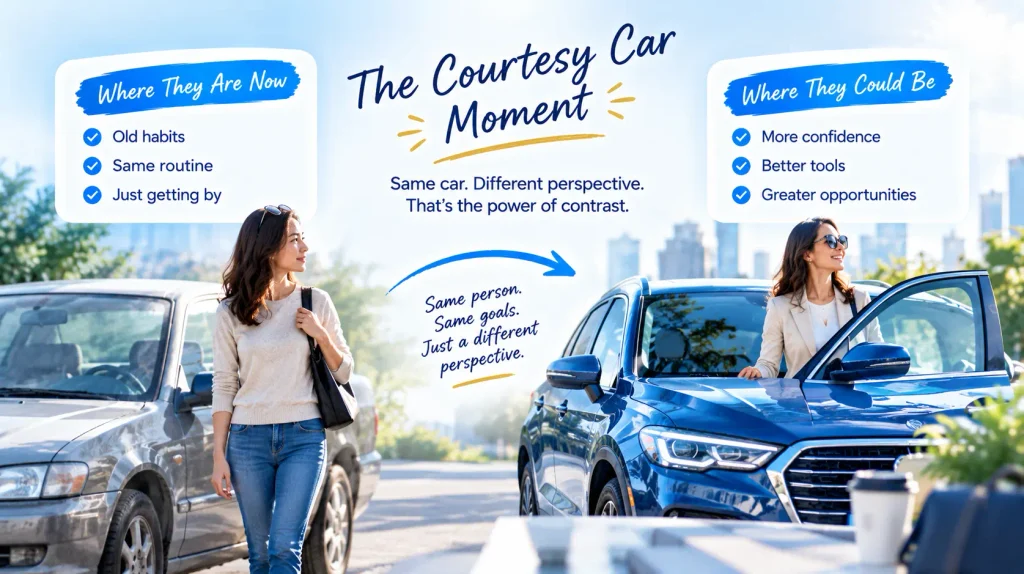
The third post type is the most powerful, because it forces a contrast. Take a before-and-after approach: paint a picture of where your audience could be in six or 12 months, and where they’ll be if they carry on as they are.
Again, you’re not calling their baby ugly. You’re telling them where they could be.
Here’s the best example I know. My wife’s car was six years old when someone drove into it. While it was in the garage, she was given a courtesy car, a brand new one with all the bells and whistles, for a week. She loved it. But she also loved her old car and had no plans to change it.
At the end of the week, she got back into her old car and suddenly noticed everything: the stains on the seats, the buttons that weren’t the same, the things that weren’t there. Nothing about the car had changed, she had simply experienced the psychological contrast effect firsthand.
Contrast makes people want to move forward. Compare where they are with where they want to be, and keep it positive.
Tips for contrast posts
- Use a timeframe: Six or 12 months makes the future concrete.
- Show both paths: Where they could be, and where they’ll be if nothing changes.
- Keep it positive: Show the opportunity, not a failure.
Your checklist for high-converting types of LinkedIn posts
- Create tension: Between where they want to be and where they are.
- Frame it positively: Aspirational, not negative or blame-y.
- Post 1: Show what’s possible when the problem is solved.
- Post 2: Show how different actions create the results they want.
- Post 3: Contrast the present with the future in six or 12 months.
Rotate through all three, and keep each one specific to your ideal client. That’s how you get the inbound leads that education alone doesn’t deliver.
Want to go deeper? Explore our Content Creation Training and Thought Leadership Training, or take a look at our free resources for post ideas.
Keep reading: LinkedIn Content That Drives Sales: 7 Questions to Ask Before You Post
If you want help creating content that brings in inbound enquiries and clients, book a call to learn how we can help.