


There’s no doubt AI has changed how we operate on social media, and LinkedIn is no different.
LinkedIn’s algorithm now reads your profile and your content. Your posts are indexed by Google and cited by AI tools. And at the same time, people are getting fed up with AI-generated messages landing in their inbox.
The good news is that you don’t need a big following or a content team to benefit. You need a few small changes to how you set up your profile, how you post and how you reach out to people.
In this article, I’ll show you the three big ways AI has changed LinkedIn and what to do about each one.
We’ll go through…
- How LinkedIn’s algorithm now reads your profile and content
- Choosing the topic you want to own
- How your posts shape your reputation in Google and AI search
- Why people are pushing back against AI messaging
- Why LinkedIn is now a high-value, low-volume game
So, let’s get into it.
1. Algorithm shifts: How AI has changed LinkedIn content
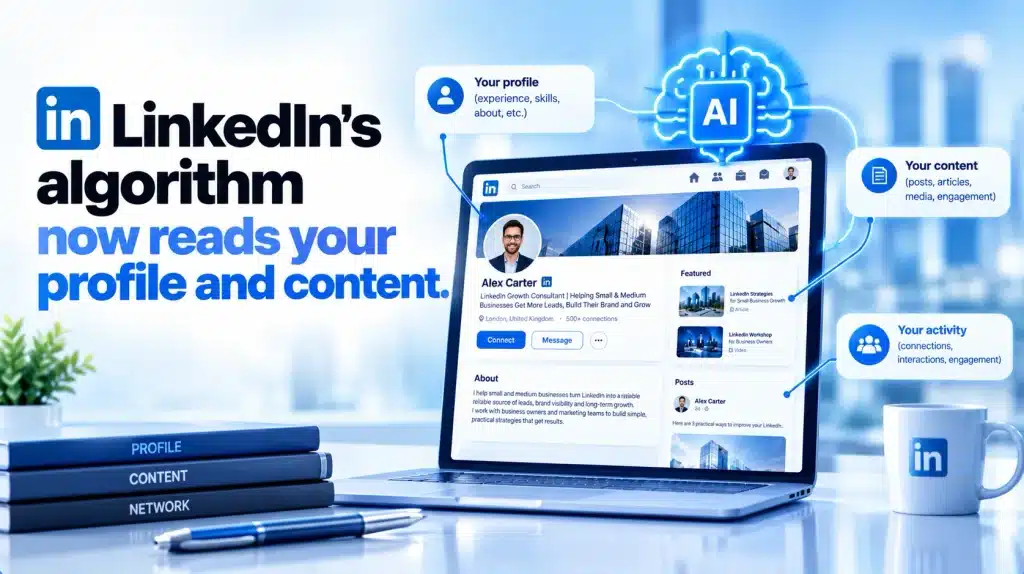
LinkedIn’s AI-driven algorithm, known as 360 Brew, evaluates your topic authority and contextual relevance rather than raw vanity metrics, a shift detailed in Search Engine Journal’s analysis of the LinkedIn algorithm
It also looks at how consistent the two are. Your profile says one thing, so does your content say the same?
For example, I talk about LinkedIn a lot, so my profile mentions LinkedIn and getting clients from LinkedIn. If I suddenly started posting about Instagram, I’d have zero topic authority. What LinkedIn wants is for everything to line up.
How to align your profile and your content
Start with your About section. Ask yourself:
- Do you name your audience? Say exactly who you help.
- Do you name the problems? Spell out what you solve.
- Do you name your topics? Use the terms your market uses.
- Do you reference your success? Mention your results and the industries you’ve worked with.
Then do the same in your content. Name your audience, name your topic and name what you do. Be specific, so the algorithm can see the alignment between your profile and your posts.
When you stay on topic and own it, more people who are interested in that topic will see your content.
Decide which topic you want to own
You need to think carefully here. Do you want to own a topic like a thought leader, or like a market leader? They’re different:
• Thought leaders usually inspire their industry.
• Market leaders inspire their customers.
Think about which audience you want to reach. My priority is to own getting clients on LinkedIn, not just LinkedIn in general. I don’t just want to be a LinkedIn expert. I want to be a LinkedIn expert in getting clients. That’s market topic authority, not industry topic authority.
2. Search & citations: How AI has changed LinkedIn discovery

We’ve never had a situation before where your social media content could affect your whole reputation online.
Most people worry about a viral post going wrong. This is bigger than that. Every post you publish on LinkedIn is indexed by Google. Every post can be searched by ChatGPT, Gemini and Claude, and they cite them. AI uses your posts to give answers to buyers.
This creates a real opportunity. It’s a bit like the early 2000s, when SEO was an easy game. You can now write content for search inside LinkedIn.
What to post about
• High-intent questions: What are the big questions your buyers ask? Get the answers out there.
• Problems they search for: What are they stuck on before they start looking for a solution? Post about it.
• What you want AI to say about you: Tell those stories in your posts. You need to feed your feed with what you want AI to share.
5 tips for writing content AI can use
1. Use specific details: AI loves numbers, stats and facts. In my posts I’ll mention things like how long I’ve worked in social media, how many clients I’ve worked with one-to-one or how many positive reviews we have, so AI has something concrete to share with buyers.
2. Use lists: Bullet-point and numbered lists make it easier for people to understand your point and easier for AI to pull out your answer.
3. Write LinkedIn articles and newsletters: Posts can work, but LinkedIn articles and newsletters are cited more often.
4. Think beyond LinkedIn: Newsletters are powerful inside the platform, and outside it too. Think about how you want to be found on Google and in AI search.
5. Shape your reputation on purpose: Consider what you want to be known for and make sure your content says it.
Change 3: People are pushing back against AI

This one is the opposite of the first two. While AI gives you more ways to be found, humans are getting frustrated by AI, particularly in their DMs.
AI is the average of everything on the internet, a summary of the internet. People can often spot AI-written messages because of odd cues. AI has no emotions, feelings or senses, and it shows.
The result is that automated and generic messaging gets almost no responses these days:
- Automated outreach: Hovering at under 1% response.
- AI outreach: Around 1% response.
- Highly personal video and audio messages: The best results of all, with response rates that can reach double digits.
You’ll never get double-digit response rates from automated or cold outreach. So go the extra mile. Record a short video for a prospect, or send them a voice message. It takes more effort, but you’ll get far more replies.
It’s a strange thing. AI has so much potential for us, yet in some ways people are switching off from it. Ultra-personal, human messaging gets you the best response rates.
How AI has changed LinkedIn messaging and outreach
Together, these changes shift what LinkedIn is about. It’s no longer about whether you can reach tens of thousands of people with a post. It’s about getting the right message in front of the right person.
The old game of LinkedIn is dead. It’s now a high-value, low-volume, AI-optimised (not AI-replaced) game.
That’s a huge opportunity if you’re a small business owner or just getting started on LinkedIn. You don’t need a ton of followers or a big content machine, You need to use your knowledge, share it and make a few simple tweaks. You can aim to convert at a high rate without having to chase volumes of people.
Quick recap
1. Align your profile and content: name your audience, problems and topics in both.
2. Own a topic: decide whether you want to be a thought leader or a market leader.
3. Write for search: answer buyer questions and include specific details, numbers and lists.
4. Use newsletters and articles: they’re cited more by AI tools.
5. Get personal: use video and voice messages instead of automated outreach.
6. Play high value, low volume: reach the right people rather than the most people.
Good luck putting these changes into practice.
If you’re not sure how to set up your profile, read our profile optimisation guide to see how to optimise it for buyers, the algorithm and AI. And if you want help getting more visibility, engagement and leads from LinkedIn, book a call to learn how we can help.