

Every post you publish on LinkedIn can now be cited or used by AI. That includes your newsletters, articles and posts. It’s a bit like a great reset on SEO, and it’s an opportunity to get in early. This article asks one question: what are you telling AI to tell other people about you? Then it gives you a practical plan so you get recommended by AI search when buyers look for help.
We’ll go through…
- Why AI search matters for buyers
- How to build your credibility for AI
- How to choose a complex problem to own
- Why niche beats broad, in search and on LinkedIn
- A simple two-step plan to start this week
So, let’s get into it.
Step 1: Why buyers use tools to get recommended by AI search
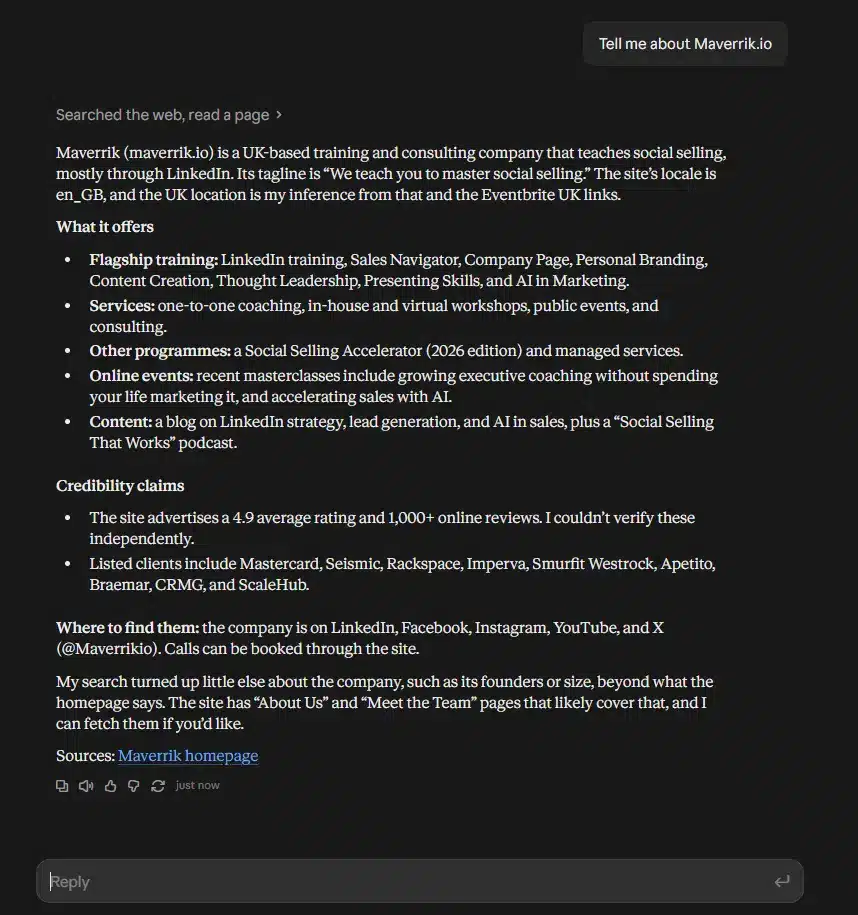
When buyers research you, they increasingly turn to AI. If they’re seriously considering you, they may ask about you by name. If they’re looking for someone to solve a problem, they’ll ask who can help. Either way, AI will say something, and what it says depends on what’s out there about you.
There are two things to get right:
1. Your credibility: Does AI understand your track record, results and experience?
2. Your positioning: Does it know which problem you solve and for whom?
For more on how this works for LinkedIn newsletters, read how to create a LinkedIn newsletter that generates leads.
Step 2: Build credibility to get recommended by AI search
Many experienced people don’t weave their credibility into their content. If you have 15 years in your industry, have worked with hundreds of businesses or speak at events around the world, those facts need to appear in what you publish. Not as bragging, but as natural nuggets that show you have a track record and aren’t some random person.
Ironically, the people with the longest track records are often the ones not doing this, while those with less experience but more technical know-how are. When a buyer is checking whether you’re credible, there needs to be enough evidence for them to make a positive decision.
Think about how a line would look if an AI repeated it to a buyer. According to Google’s official guidance on AI features in Search, AI-powered search tools prioritise helpful, reliable, people-first content backed by clear factual evidence rather than vague claims.
How to do it
1. Make a list: Open a document and write down your history, track record, successes, results, numbers and the names you’ve worked with.
2. Weave it in naturally: Use at least one fact in each post, such as “over the last 15 years I’ve worked with more than 500 clients”.
3. Don’t stuff keywords: It needs to read organically, not like a flex.
A caution about personal stories
A lot of content that works on LinkedIn is personal: failures, doubts, your journey. In a search context, some of that could work against you. For example, AI might pick up a line about being nervous when you land a big contract and present it as doubt. Some things that work on social media can harm you in search, and some things that feel flat on social media help you in search. Think about how a line would look if an AI repeated it to a buyer.
Step 3: Own a complex problem to get recommended by AI search
It’s very difficult to dominate big, broad topics such as coaching, mindset or audit, and chasing them can turn into a rat race: you get to the top, someone takes you down, and you start again. Most people searching those broad terms also aren’t buyers.
Instead, choose a complex, nuanced, expensive problem for a specific persona. For example, rather than “confidence” in general, a problem that a particular type of leader faces. When someone in that group searches, AI starts recommending you.
Why complex problems work
1. Less competition: There’s less content on niche problems, so it’s easier to stand out.
2. It’s where the money is: People with a complex, costly problem are motivated to pay.
3. AI is less likely to solve it for them: There isn’t enough data for AI to answer it well, so a specialist has an edge.
4. It’s a moat: Once you own it, you become the go-to.
This links to the Signal Framework: you pick a specific problem, promise and persona and make everything about it.
Step 4: Don’t fear the niche
Many of us avoid being specific because we might miss out. A managed IT provider that is excellent with law firms may avoid saying so in case other industries go elsewhere. That’s fear talking.
Ask a different question: is there enough business in the niche? A hundred law firms within a reasonable distance may be more than you need. Owning a niche makes you the first choice. Trying to appeal to everyone makes you the middle-of-the-road option for nobody.
It’s a useful route if you don’t have huge resources. A solo business can dominate a complex niche problem where there are perhaps 10,000 potential customers. You won’t get millions of views, but the views you get will be from people with money and motivation.
Step 5: Go for quality, not volume
Dean describes two business models in the social selling world:
1. Volume: Build a big audience and sell lots of low-priced products and courses. It’s legitimate, but it takes a lot of ongoing effort and doesn’t scale easily.
2. Low volume, high value: Sell high-value services to fewer clients. Implementation is messier, but you need fewer clients to make more money.
The same goes for search. Don’t chase big volume that brings lots of irrelevant people. Go for the high-intent questions, which are the searches people make when they want to pay for help. For example, instead of basics, think of questions like “how do we upskill our team in this?”
Your content may not go viral, because the market for a niche problem is small. But viral isn’t the goal. If the market is much bigger than a few thousand people, you may be in a generalised problem that people won’t pay for, or that AI will solve for them.
Your two-step plan to get recommended by AI search
1. Write your credibility document. Include your history, stats, results and names. Weave at least one into each post or article.
2. Choose the niche, high-intent, complex problem you’ll own, then make your content about it. Do the same on your website, company page and press releases, and keep answering the high-intent questions.
Over time, AI starts to show you as the go-to person for that problem, and the people who find you are ready to book a call.
Want to go deeper? Explore our Content Creation Training or take a look at our free resources.
Keep reading: How to Sell Your Expertise on LinkedIn
If you’d like help choosing and owning your niche, book a call to learn how we can help.