

If you want to sell your expertise on LinkedIn, you don’t need hundreds of clients. Most people I talk to need one or two good ones a month, paying proper fees, and they’re set.
The trouble is that most LinkedIn advice is about volume. So you end up spending hours on content and comments, and the effort never seems to match the reward. You didn’t start your business to become a full-time marketer, content creator or salesperson.
This article maps out the system I use so you can spend less time on client acquisition, win better-quality clients and keep the whole process simple.
We’ll go through…
- Why you should work backwards from the result
- Why LinkedIn is a market you have to adapt to
- How to settle your proposition with the 7 Ps
- How to pre-sell so people believe you
- Why going narrow gets you clients faster
- How to choose one path to leads
- How to get leads on calls and close them
I call it the 3P framework: Proposition, Pre-sell and Pipeline. It’s the framework I walk every client through, because it’s the key to getting results.
So, let’s get into it.
Step 1: Work backwards from your revenue goal to sell your expertise on LinkedIn
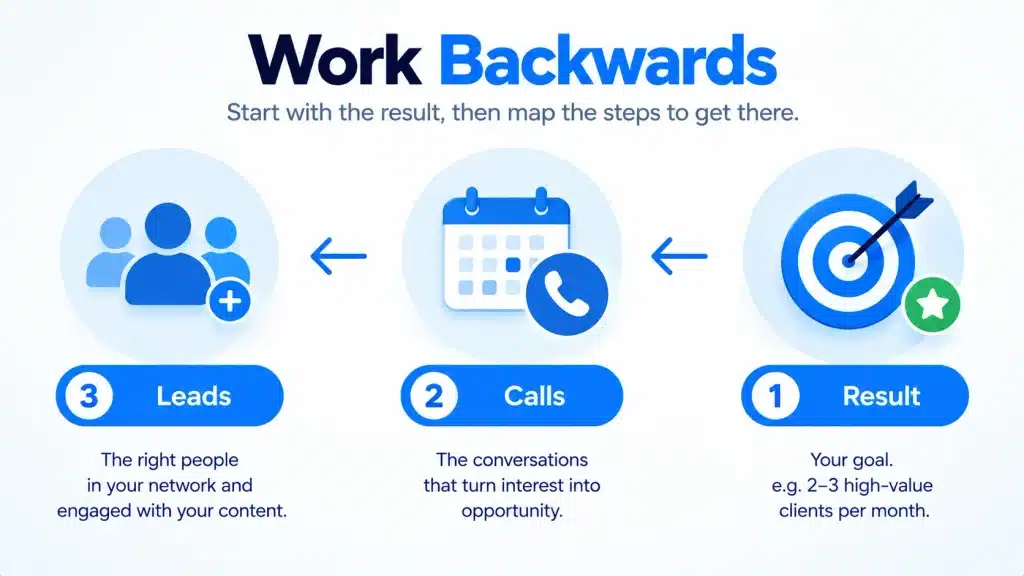
Most people start with action. “If I do lots of activity, surely I’ll get a result.” Instead, start with the result and work backwards.
Say you want two to three new clients a month, at around 5k each. That’s 10 to 15k a month. Not every conversation turns into a client, so here’s a safe set of numbers:
- 30 quality leads to get to…
- 10 calls, which gives you…
two to three clients.
Many people close 50% of the calls they take, but I use a third because it’s a fair, safe number. Why 30 leads? Some won’t be in the market right now, some will need nurturing and some won’t want to go any further.
Now you have something to work on. Instead of “do lots of stuff and hope”, you have a metric: how do I get 30 quality leads? When my clients start here, everything gets easier.
Why you want more demand than you need
If you only have one lead, you’ll compromise. You’ll take on a client who isn’t a good fit and who saps your time. What you want is three or four potential clients so you can choose the ones you really want to work with, and so your price holds up.
The business killer is unpredictability. It’s easy to take your eye off the ball, get stuck in delivery and suddenly find a gap. That’s why you need a system that gives you more opportunity than you need.
Tips for working backwards
1. Pick your number: Decide how many clients you need a month and what each is worth.
2. Count your leads: Work out the number of leads and calls that gets you there.
3. Judge effort against it: If it takes an hour of work to get one lead, something in your approach is wrong.
4. Ignore “brand awareness”: It’s nice, but only if it yields revenue.
Step 2: Adapt to the market when you sell your expertise on LinkedIn
LinkedIn isn’t just a social media platform. It’s a market. That doesn’t mean being cold. It means that when you enter a market, you adapt to it.
Think about a UK business selling in the US, or the other way round. We both speak English, but words don’t always mean the same thing, and we buy and make decisions differently. You’d adapt what you offer to that territory. LinkedIn is the same.
If your business is built on referrals, this is where it catches people out. Your way of working, on calls, in marketing and with customers, has been shaped by referrals. Bring that approach into LinkedIn and you’ll fail. A LinkedIn lead isn’t locked in the way a referral is, because they don’t have a recommendation from someone they trust.
The 3P framework takes the business you have in the real world and makes it viable in the digital one.
Step 3: Settle your 7 Ps to sell your expertise on LinkedIn
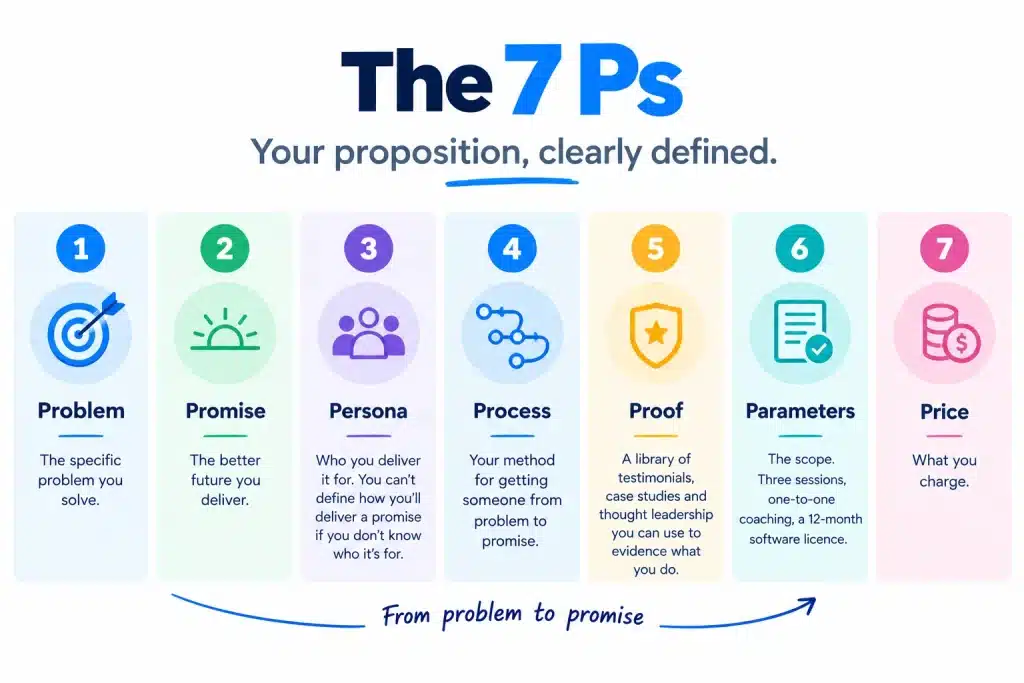
This is the foundation. Without it, nothing else in this article works. Think of it as a once-and-done setup for a new market.
There are seven things you have to decide:
1. Problem: The specific problem you solve.
2. Promise: The better future you deliver.
3. Persona: Who you deliver it for. You can’t define how you’ll deliver a promise if you don’t know who it’s for. This is the number one failure on LinkedIn, and in marketing generally: talking to someone you haven’t defined.
4. Process: Your method for getting someone from problem to promise. A method isn’t coaching or a course. It’s an approach, a way of doing it. Every business has one, they just never write it down. Once people believe in your method, they’re in.
5. Proof: A library of testimonials, case studies and thought leadership you can use to evidence what you do.
6. Parameters: The scope. Three sessions, one-to-one coaching, a 12-month software licence.
7. Price: What you charge.
For more on this, read our guide on how to build a profitable personal brand.
Two objections I hear a lot
“I sell intangibles.” You’re not. If you know who the person is, the specific problem they have and where they want to get to, you can build a process to get them there. Everybody buys outcomes. If you feel you’re selling something intangible, you’re selling the parameters of what you do, not the promise.
“I’ve got 25 years of experience.” To people who don’t know you, that means nothing. There are people with less experience than you, and less skill, making more money, because they’re very clear on their 7 Ps.
Get comfortable with your price
Many experts feel awkward about money. That matters, because selling is psychology, yours as well as the prospect’s. If you feel uncomfortable about your price, it shows up on calls as a lack of confidence in what you’re selling, and you scupper your own sales.
So desensitise yourself to it. What worked for me was talking about my price publicly. And if you’re worried someone will copy you and undercut you, remember that people don’t buy from you because you’re the cheapest.
If you haven’t defined your 7 Ps, you can’t effectively sell your expertise on LinkedIn.
Step 4: Pre-sell your authority to sell your expertise on LinkedIn
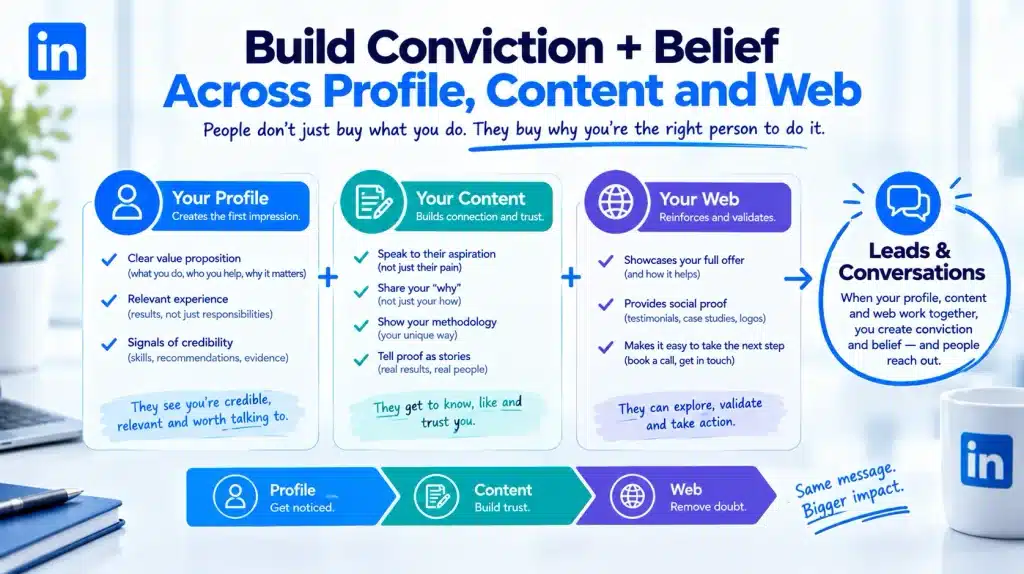
Pre-selling is simple. People need to see two things from you:
1. Conviction: Do you back yourself? Would a visitor find enough evidence in your profiles to show you believe your offer can change a business or a life?
2. Belief: Do they believe your 7 Ps will work for them?
You build both across three places, because nobody buys from a complete stranger, and nobody buys after seeing you once.
Your profile
Your profile has to educate people on all seven Ps, because it’s where they’ll check you out. If I can’t see proof that you’re good at what you do, or how I can buy from you, you’re doing yourself a disservice.
Your content
Post a couple of times a week, rotating around the same issues. This isn’t promoting your process every time. People don’t trust promotion. It’s explaining and demonstrating how you think, with no sales agenda, so they build a picture that you believe what you say, and that it makes sense for them. Everything should compound.
Many people find their content educates, but is only loosely linked to what they sell. It’s on the same topic, but isn’t reinforcing their 7 Ps.
The web
Before people invest serious money, they’ll Google you. If you’ve relied on referrals, that evidence might not exist. You could have 25 years of experience and be a nobody online.
Your LinkedIn posts, your website, other social channels, forum contributions and press releases all get picked up by tools like ChatGPT. This is a long-term build, but your profile and content can start this weekend.
Tips for pre-selling
1. Don’t avoid your offer to avoid looking salesy: It makes it harder for people to buy, which means you have to sell harder.
2. Set your profile up once: Once the 7 Ps are settled, your profile can work for you for six months.
3. Show how to buy: Make the offer visible on your profile.
4. Stay consistent: The average LinkedIn session is short (around seven minutes, by my numbers), and you’re a sliver of that, so you need several touchpoints.
5. Start now and build as you go: Don’t wait six months to build your online backstory.
Step 5: Specialise and go narrow to sell your expertise on LinkedIn
“But Dean, I can help people in lots of different ways. I don’t want to miss opportunities.”
I can too, I could be an all-round marketing consultant. I can help with LinkedIn, email, websites and sales, and inside our programme we help people build their offer, messaging and follow-up. But I strategically chose to focus on social selling, because I make more money, faster and more easily.
Going broader means way more pre-selling. People have to work out that you can help with their specific thing. Going narrow makes everything more efficient when you sell your expertise on LinkedIn. It’s the Red Bull strategy: rather than take on Coca-Cola head-on, own a small segment first and expand from there.
Why it all connects
If you can’t define your persona, your pre-selling gets fuzzy and fills with abstract phrases. One person I spoke to said, “I help you get clarity.” About what? Nobody wanders around saying, “I need more clarity.” He was bundling three different problems into one vague statement.
The same thing then happens further down the line. You don’t know what your event or newsletter is about, because you have three personas in your head. You can’t write a lead magnet that resonates. And you can’t prepare for calls, because the problems differ every time.
When you see the same problem over and over, you become a specialist in that problem and that audience. You recognise patterns on calls, your proof is relevant and everything gets simpler, quicker and better converting.
Step 6: Choose one lead path to sell your expertise on LinkedIn
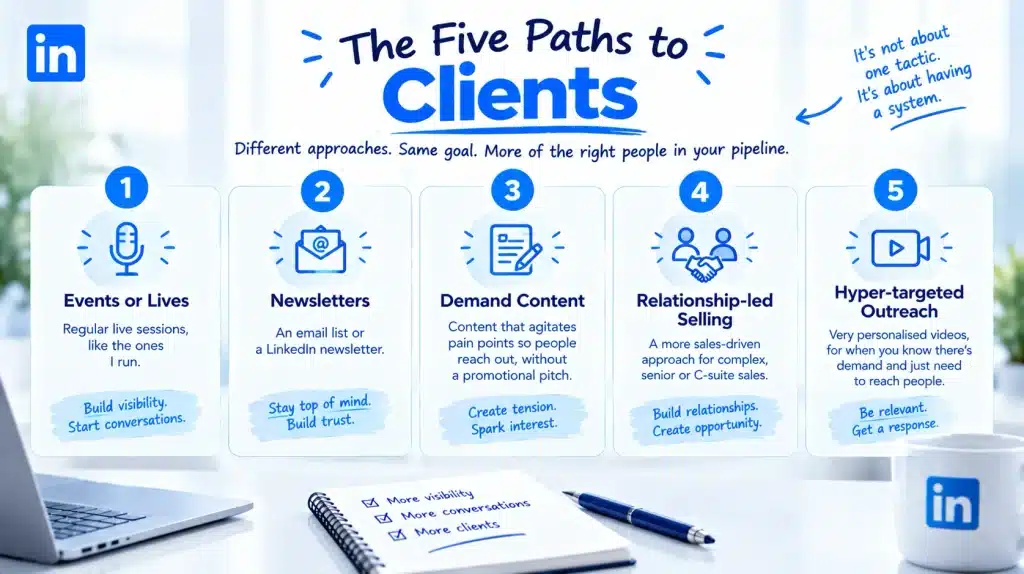
Now for the part where everyone gets excited. You need a path to get leads or inbound enquiries. I teach five:
1. Events or lives: Regular live sessions, like the ones I run.
2. Newsletters: An email list or a LinkedIn newsletter.
3. Demand content: Content that agitates pain points so people reach out, without a promotional pitch.
4. Relationship-led selling: A more sales-driven approach for complex, senior or C-suite sales.
5. Hyper-targeted outreach: Very personalised videos, for when you know there’s demand and just need to reach people.
If you’re an expert, the first three are the ones for you. And here’s the rule: master one, not all. Try to do all three and it’s too much work. You’ll be average at all of them and burn out.
Once you’ve picked, build a simple SOP: what you do each month, and how long it takes. Most of it can be templated and repeated. Once the setup is done, you can run it in around 30 minutes a day. You go on LinkedIn, do your thing, leave and get on with client work.
Read more on the paths in our article on how to get leads on LinkedIn.
High value, low volume means being relevant, targeted and focused. You won’t become a viral sensation, but most of the people telling you to go viral are selling a course on how to go viral. You just need paying clients.
Step 7: Get leads on calls and close them
A lead isn’t a client. Once someone signs up for your event, joins your newsletter or downloads a lead magnet, you need to get them on a call.
Getting the call
You don’t sell a 5k, 10k or 50k service by sending a payment link. Most people don’t have the sales skills for that, and don’t want to learn them. And just asking “do you fancy a call?” won’t work either unless it’s a referral. People need to see what’s in it for them.
Running the call
Uncover why they want to solve this problem, their specific problem and the outcome they want, in their context. Then propose how you’d fix it, and follow up with a proposal so the momentum doesn’t fade. A common mistake is explaining what you can do while the prospect can’t see how it fits, or why they should act now.
Closing
This isn’t about a dodgy jacket. After a call, interested people cool off. If all you do is chase with “just checking in”, the reason they needed to act gets lost. Have a plan to keep the momentum.
As Atomic Habits puts it, you don’t rise to your goals, you fall to your systems. So ask yourself: what’s your system for getting leads? For getting them on calls?, For running those calls? For closing?
Your checklist to sell your expertise on LinkedIn
1. Work backwards: Pick your target clients, then 10 calls and 30 leads.
2. Treat LinkedIn as a market: Adapt your referral approach.
3. Settle your 7 Ps: Problem, promise, persona, process, proof, parameters, price.
4. Pre-sell: Show conviction and build belief through your profile, content and the web.
5. Go narrow: One persona, one problem, one promise.
6. Master one path: Events, a newsletter or demand content.
7. Run the system: Leads, calls, proposals and follow-up, written down as an SOP.
If you’re a subject matter expert who doesn’t want to be a marketer, a salesperson or someone who lives on the platform, learning how to sell your expertise on LinkedIn with a repeatable system gives you more demand than you can supply, and protects your price.
Want to go deeper? Explore our Social Selling Accelerator and one-to-one coaching, or take a look at our free resources.
If you want this system running in your business, book a call and we’ll map out your 90-day plan. Book your call here.