

In this article, I’ll walk you through exactly what I do to generate inbound leads on LinkedIn, and why I do it. It comes down to three things: content, a newsletter and events. You can adapt all three to suit your own business, whatever your size.
LinkedIn is a very different platform to the one it was a few years ago. There are more people on it, more people scrolling it and a lot more noise to cut through.
So if you’re trying to get leads on LinkedIn and it isn’t working, you’re not alone.
We’ll go through…
• Starting with the end in mind
• Fixing your profile first
• Knowing what your audience will actually pay for
• Posting content that creates demand
• Using a LinkedIn newsletter to start conversations
• Running LinkedIn events
• What to expect in the first 90 to 180 days
• Keeping your emotions out of it
• What to do if you’re a salesperson
So, let’s get into it.
Start with the end in mind
Before you post anything, you need to know how you’re going to use LinkedIn, and I mean that literally. What are you going to sell? Who is going to pay you for it? And why are they going to pay?
If you haven’t defined that, LinkedIn gets messy very quickly. Even the biggest influencers on the platform know exactly what they’re trying to sell and who they’re selling it to.
Your content strategy, your profile and your connection strategy all come out of that decision. Who am I connecting with? What should they see on my profile? What should I be posting about?
If those things don’t link together, you’ll get one of these outcomes:
• Posts that get random engagement, or none at all
• Posts that never turn into inbound leads
• A growing network where nobody sees why they should buy from you
• More reach, but no results
For example, my team and I focus on small business owners who want LinkedIn to work for them. Can we sell to corporates? Yes. But on LinkedIn, that isn’t my objective, so my profile and my posts are built for small business owners.
Fix your profile to attract inbound leads on LinkedIn
If you want consistent inbound leads on LinkedIn and you haven’t fixed your profile, you’re making life much harder for yourself.
Everything on LinkedIn revolves around your profile. It’s how people check you out and figure out what you do.
Think about the journey from “I don’t know you” to “I’m ready to buy from you”. A big chunk of that journey happens on your profile, with people looking at it, clicking around and reading what you’ve shared.
If you’re focusing on lead generation and you haven’t fixed your profile, you’re making life much harder for yourself.
So before you spend time on posts, newsletters or events, make sure your profile supports the people you want to attract.
Know what your audience will pay for
This is the biggest disconnect I see with experts. There’s a difference between knowing your topic and knowing what people will pay for. They overlap, but only in certain places.
To get people to enquire, you need to make them curious about something they really want to achieve. That’s either a problem they want to leave behind or a goal they want to reach. The sweet spot is using both.
If there’s a gap between what you want to sell and what people are ready to pay for, you will struggle to gain traction. Building a profitable personal brand requires aligning your 7 Ps so your proposition speaks directly to an existing commercial want.
Convincing people to buy something they aren’t already motivated to buy is very hard. You have to educate them heavily, and most people won’t stick around for that.
What happens if you skip this
Your content ends up educational and helpful, but it doesn’t drive demand. You can also end up attracting the wrong people.
If you only write about what you think is good, you appeal to people like you. And people like you are probably your competitors, or people who have already solved the problem. They’ll like your posts, but they won’t buy from you.
Here’s the simple version. If I help lawyers become confident in the courtroom, my profile clearly shows how I do that, I connect with lawyers who go into courtrooms, and I post about being confident and successful in the courtroom, then I shouldn’t be surprised when lawyers who want that start contacting me.
1. Content: Posting for inbound leads on LinkedIn
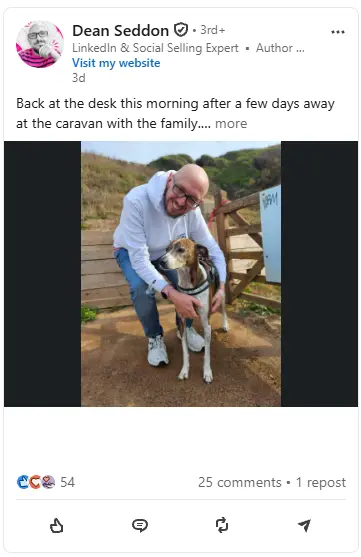
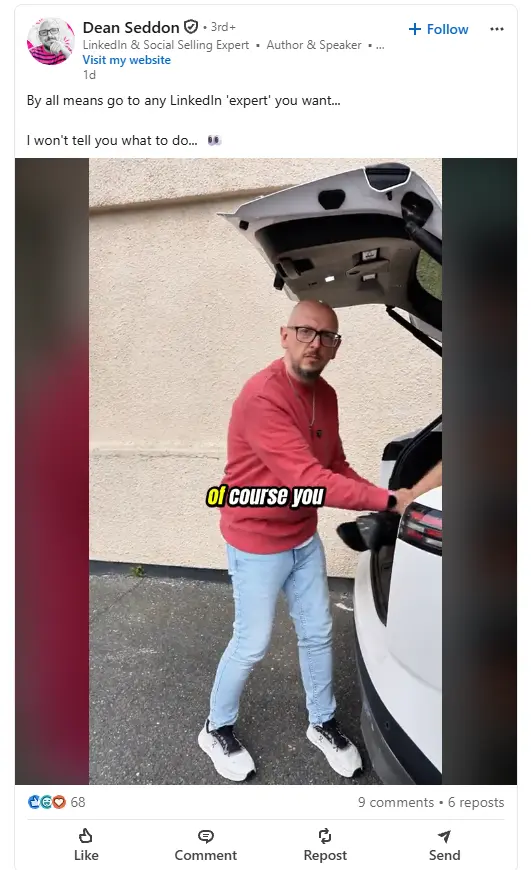
I generate inbound leads on LinkedIn every day, and that’s down to the compounding effect of everything I’ve published, not one big hit.
Posting is my long-term play. I’ve posted daily for years and I post five times a week now. You don’t need to post that often, but I enjoy it, so it’s become a habit.
Some posts do well and some don’t. I don’t bank on any single post. I get inbound leads every day, and that’s down to the compounding effect of everything I’ve published, not one big hit.
Content has a second benefit too. A lot of what I post also helps me show up in Google and AI search.
6 tips for posting content that gets leads
1. Rotate around the reasons people buy: Know why your ideal client will buy from you, and make your content revolve around those reasons.
2. Write episodic content: I’m a huge Star Trek fan, and the original episodes are so rewatchable because each one stands alone. Your posts should work the same way. Assume the reader has never seen you before. If they need to know your backstory to understand a post, you’ve lost most of your audience.
3. Use simple formats: I mostly stick to images because they’re easy. I sometimes do carousels or video, but I don’t overcomplicate it.
4. Show your face: I use a lot of personal and phone photos. I want people to recognise me and feel they know me, and in my experience branded graphics don’t work as well for building trust.
5. Check who is engaging: If your comments are full of competitors and people who’ve already solved the problem, your content is aimed at the wrong people.
6. Don’t judge every post: Don’t beat yourself up over whether a single post is good or bad. It’s the compounding effect that counts.
2. Newsletters: Nurturing inbound leads on LinkedIn
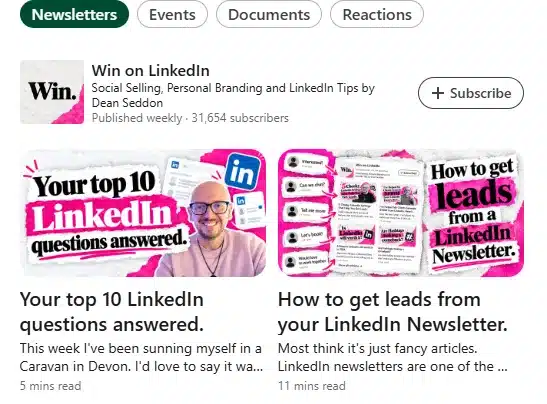
This is my biggest one. Newsletters have brought me more inbound leads and more revenue than anything else I’ve done on LinkedIn, and a lot of the conversations I have start from them.
I publish two, one every week. One is about winning clients on LinkedIn, and the other is about moving beyond referrals, because many of the people I work with rely heavily on them.
Long-form content converts at a higher rate than short-form. In many ways, short posts are the top of your funnel, and long-form content is the middle and bottom.
A LinkedIn newsletter works with the platform instead of against it. Aligning with HubSpot’s inbound marketing methodology, publishing consistent, educational content lets buyers opt in and self-educate, giving you a warm audience to start conversations with rather than relying on cold interruption.
Why publish on LinkedIn rather than your website?
Getting people from social media to your website is hard. The platforms don’t want you to do it, they want you to pay for ads. A LinkedIn newsletter works with the platform instead of against it:
• LinkedIn invites people for you: Every new connection, and all your existing ones, are invited to subscribe automatically. I have around 30,000 subscribers.
• LinkedIn notifies them: When you publish, subscribers get a notification.
• LinkedIn emails them: Around 40% of LinkedIn users get email notifications, so many subscribers receive an email teaser of your newsletter.
• You can see your subscribers: You can see who has subscribed, so you can start conversations with new subscribers and people who engage.
Even if you only have around 1,000 connections, you could get 300 to 400 subscribers within 30 days of launching a newsletter. That’s enough to start conversations every single day.
How to follow up with newsletter subscribers
Don’t pitch. Just have a conversation. If someone subscribes or engages, message them.
I think of good selling as being like booking an appointment with a good coach. The coach doesn’t tell you what to do or lead you somewhere. They draw out what you want and what matters to you. If there’s a fit, they offer to help. Sales is helping people uncover their need and seeing whether there’s a match.
I give my clients a template to adapt, because it’s easier to adapt something than to start from scratch. One of my clients says he gets more from following up newsletter interactions than he does from posting content.
In the beginning, you might not be great at managing these conversations. That’s fine. Having a few more conversations than you need helps you learn what works and get comfortable faster.
Each edition of my newsletter also has a clear structure: some value, a next step and a clear way to get in touch. Some editions lean towards value and others towards how I can help.
3. Events: Converting inbound leads on LinkedIn
Every week for the last six years I’ve run a free session to help people with what they’re struggling with, which is getting clients from LinkedIn. I’ve had around 125,000 sign-ups in that time.
I don’t do the slick webinar with the countdown clock and the sob story. I turn up, deliver value and follow up with everyone who signed up.
Most people don’t watch live. They watch the replay. After every event, some people ask for the resources and some ask for a call. I follow everybody up and invite them to have a conversation.
Why the rhythm matters more than any single event
When we looked at the inbound leads that turned into paying clients, the majority had signed up to at least two events.
One of my clients, who works in AI and cloud, ran two events. The first generated a small number of leads. After the second, he followed up with someone who had been to both, which led to a meeting and a €250,000 opportunity.
I run a weekly event because I have a large team and need a high volume of clients. You probably don’t. One event a month is totally doable. Follow up everyone who signed up, everyone who interacted and everyone who messaged you.
It also took me time to get there. I didn’t get inbound leads saying “Dean, tell me how you can help me” at the start. I had to work at it until they came.
What to expect in the first 90 to 180 days
When you start content, a newsletter and events together, the return on paper will look questionable for the first six months. The stories about making $100,000 from a single tactic are the outliers.
Inbound enquiries don’t come because someone saw something once or twice. They come from seeing a consistent message over and over until they decide now is the time.
So in the first 90 days minimum, you follow up the interest you’ve already created:
• Talk to your new newsletter subscribers
• Talk to the people who engage with your posts
• Talk to everyone who signed up to or interacted with your events
That’s reactive follow-up, not cold pitching. It isn’t exciting, but it works. The approach is boring, but it’s easy. You don’t have to rely on one post that day to get a lead, and you don’t have to send a pile of sales pitches to get one.
Why consistency beats the “big hack”
I learned this the hard way. I started my first business at 18 and got lucky with a couple of great referrals. I assumed that business was mine for good, so I never built a way of getting leads. When those referrals went to tender and I retained only a sliver of the work, I panicked and chased shiny objects, jumping from one hack and one industry to the next.
What turned things around was doing the same simple things over and over, every day. The company where I did that grew from about £500,000 to nearly £2 million.
Looking back, there were two problems, and they’re the same two problems that stop people getting leads on LinkedIn:
1. I wasn’t focused on what I was selling, who would buy it and why.
2. I wasn’t focused on the activity that would get me leads and clients.
It isn’t that you don’t understand the platform, and it isn’t the algorithm. It’s doing the wrong things without focus.
I think of LinkedIn as a big networking event. There are lots of ways to work the room, and the intent you bring matters. If you wander around hoping to sell to whoever you bump into, good luck. If you ask who you actually want to talk to and whether this is the right room, you’ll get much further.
Keep your emotions out of it
LinkedIn is spending a huge amount to keep you on the platform. If it knows you want leads and clients, your feed will fill up with tactics, tricks and tips on exactly that, because it wants you to keep searching, scrolling and trying shiny new things.
If you get emotionally attached to the outcome, you’ll be on a rollercoaster. Every post that does well is a high, and every post that flops makes you want to give up.
It happens to me too. I once lost 21 newsletter subscribers in a day (out of around 31,000) and found myself asking what was wrong with me. I’ve had events that went brilliantly and events that were a car crash, including a microphone that stopped working halfway through.
LinkedIn is a tool to generate revenue. You’ll build great relationships and a strong brand there, but don’t get emotionally connected to every result.
Some things will work and some won’t. Keep going, and use some self-discipline about how you spend your time on the platform so you don’t get dragged down rabbit holes.
What if you’re a salesperson?
If you’re a salesperson, you probably have a pipeline to fill, a quota and a manager. You may not have the luxury of waiting for inbound interest, so you’ll need to go outbound, at least at first.
The trust piece still matters, though. People are far more likely to respond to your outreach if they recognise your name. Building that visibility and name recognition is a big part of what we teach in our Seven Steps framework.
Checklist for generating inbound leads on LinkedIn
1. Start with the end in mind: know what you’re selling, who to and why they’d pay.
2. Fix your profile: it’s where people decide whether to move forward.
3. Know what they’ll pay for: build everything around that, not just your topic.
4. Post content consistently: make it episodic and let it compound.
5. Publish a newsletter: use it to start conversations with subscribers and engagers.
6. Run events regularly: most clients who buy have attended at least two.
7. Be patient and follow up: give it 90 to 180 days and keep emotion out of it.
Good luck getting your LinkedIn lead generation up and running.
If you want help getting more visibility, engagement and leads from LinkedIn, book a call to learn how we can help, or take a look at our free resources for post ideas and guides.