

A lot of people are spending real time on LinkedIn and not getting the bang for the effort. I scroll LinkedIn every day; it’s my day job, helping people get clients on LinkedIn. I’ve mentored 500 people one-to-one to help them get to positive revenue from LinkedIn. And when I want to judge whether someone’s actually going to be successful on there, I don’t look at their posts first. I look at their profile.
That tells me everything. Where their head’s at. Their thinking, their planning, their strategy. You can pick up more from three seconds on someone’s profile than you can from a week of their content.
So that’s what I want to walk through here. Not a perfect example; my own profile is mid-overhaul right now, but the logic behind why I build it the way I do, and why I tell every client to do the same.
The profile loop: How to get clients on LinkedIn
Here’s the thing most people miss. Every single action you take on LinkedIn stirs up curiosity. Posting, connecting, messaging, commenting, joining groups, even cold emailing, which is a little icky, but if you’re doing it, some of those people are going to think, “Who is this person?” and go and check you out.
All roads lead back to your profile.
If your main goal is to get clients on LinkedIn, your profile needs to do the heavy lifting before you ever jump on a call. Whether you’ve set it up to or not. I call this pre-selling. The more people understand what you do, why it matters to them, how it works, and the success you’ve already had, before they ever speak to you, the less salesy you have to be when they finally do.
I used to be squeamish about putting my pricing out in the open. Now I put all of it up front. It’s a little uncomfortable, but it beats the alternative: you’re on a call, they ask what you do and how much it costs, you say “£5,000,” and they say, “Oh, I thought it’d be about 200 quid.” What a waste of everyone’s time. Pre-selling stops that dead.
The 4-second value prop
LinkedIn is its own ecosystem. It’s a billion people, and the platform wants to keep every one of them inside it, not send them off to your website. People telling me they need to “sort their website out” before they take LinkedIn seriously are solving the wrong problem, the reality is your LinkedIn profile matters far more than your website when it comes to converting attention into clients. Nobody’s going there. It doesn’t need to play a part.
What matters is what you’re doing inside the platform. And that starts with the 4-second value prop: in four seconds, from anything you’re doing on LinkedIn, can somebody figure out why it’s beneficial to them? Not enough to make them buy. Enough to make them look a little deeper.
Most of those four seconds gets spent staring at your banner, not your profile photo. If you’re on a free account, you’ve got one static banner to work with. Premium and LinkedIn Sales Navigator give you a rotating set, which buys you more attention, because instead of losing someone in two seconds, you’ve got them a bit longer while they work out what they’re looking at.
What goes in that banner comes down to five things:
- Your promise: if someone works with you, what do they get, and how does their world change?
- The problem you speak to.
- The person: who it’s for.
- Your process: how you actually deliver it.
- The proof: a result, a testimonial, something real.
I run through all five on my own banner: my 3P framework, a screenshot of testimonials pulled from the 500-plus I’ve got on Trustpilot, my big promise and who it’s for, and a quote from a client who’s had success working with me. I could cram more in, I don’t, because the essentials are what earn the four seconds, not volume.
One thing I see constantly, and it drives me mad: people slam their logo across the banner as big as they can get it. Don’t. Your logo isn’t important. The message landing is important.
Don’t make people join the dots
Your banner, your headline, your about section: people will see these in different places at different times. A comment. A post. A connection request. They don’t always see the whole picture in one go, so you can’t split your message across sections and expect someone to piece it together. Say the same thing, in the same way, everywhere. Repetition isn’t a flaw here; it’s how a message sticks, and it’s how you build a brand around a specific outcome.
And that specificity matters more in 2026 than it ever has. Be a generalist, and AI is coming for you. Be a specialist, and you get better pricing, easier growth, and it’s easier to cut through the noise. Assume the person looking at your profile doesn’t know you, doesn’t know what you do, and isn’t going to put in any effort to find out. That’s your job, not theirs.
The profile photo: pick a lane
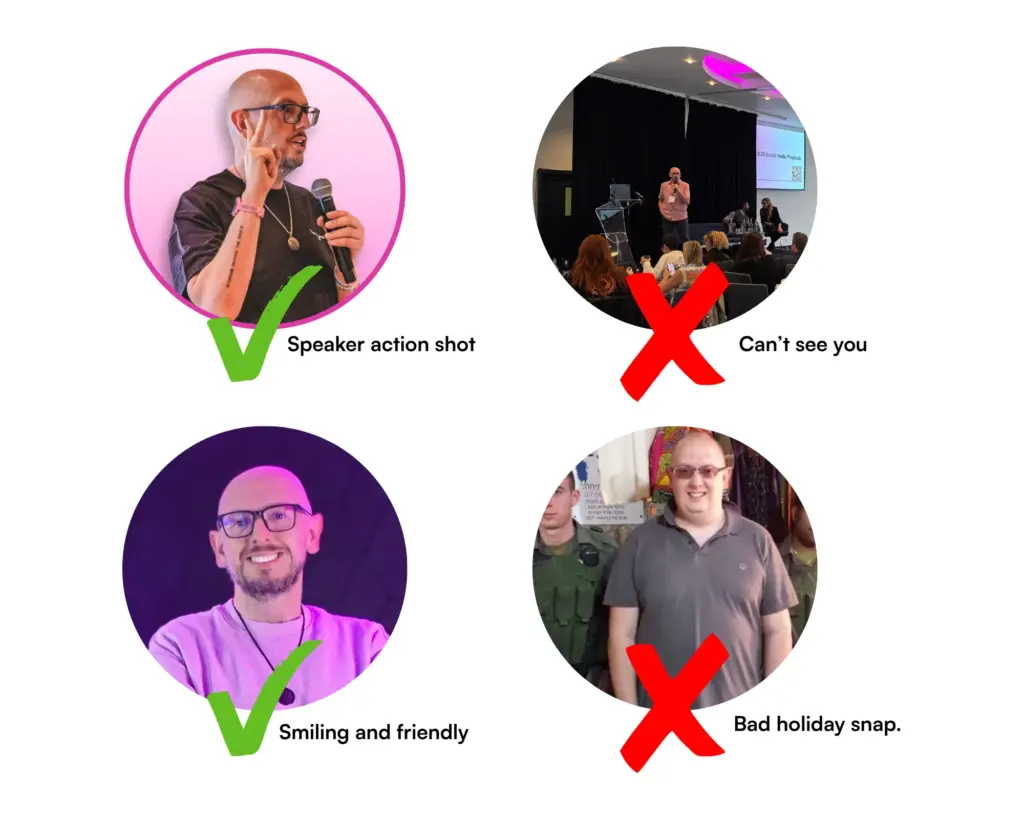
There are really two ways to run a profile picture. The authority shot: you with a microphone, animated, doing something, face clearly visible. Mine is me speaking at a conference in Arizona. I like the photo, I like the memory attached to it, and it does the job: it shows I’m out there doing the thing I talk about.
Underneath that photo, my headline reads: “Win clients consistently without relying on referrals. Social selling for expert-led businesses.” Two audiences named directly: people tired of relying on referrals, and people who sell expertise as a service- lawyers, accountants, financial advisers, professional services generally. No guessing required.
Why the about section still matters
People will tell you nobody reads the about section. I’ve said for years: most humans don’t, but algorithms do. LLMs do. AI does. The platform is reading your profile to work out who you’re for and whether your content is consistent with it. Inconsistent, and you simply don’t get shown; that’s the mechanism most people never think about.
So the about section needs the same five things as the banner: promise, problem, person, process, proof, plus two more: the specific services you offer, and the keywords or topics you talk about. Enough signal for an algorithm to categorise you properly, and enough substance for a genuinely curious buyer to read the whole thing and come away convinced.
Most people don’t read your about section. The algorithm always does.
The featured section is where most people go wrong
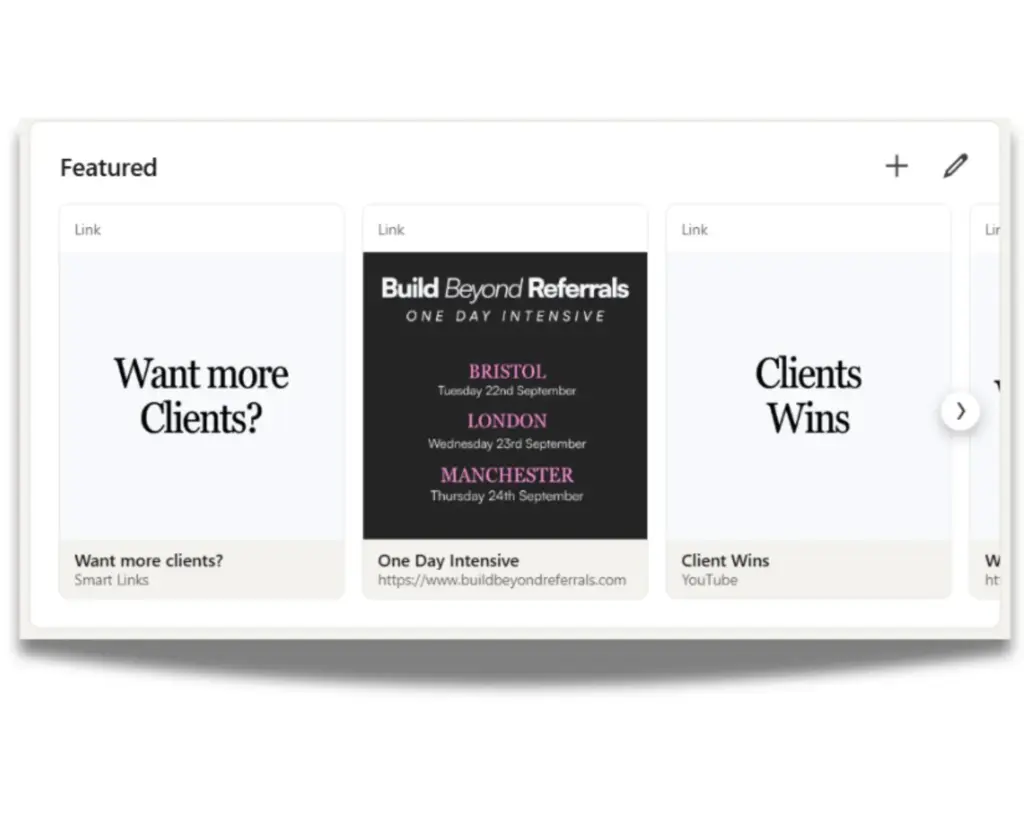
So many people get this wrong. They pin their most popular posts, the layout looks messy, and none of it draws anyone in. Mine’s plain, deliberately. The text alone should make someone think, “What’s he talking about? I want more clients,” and click through. That’s the entire job of this section: it’s one of the only places on your profile where you can point people somewhere specific. Use it.
I put my core offer here without hesitation, a “want more clients” panel that opens into a short brochure explaining what I do, prices included. Some people flinch at that. I’d rather someone see my one-to-one coaching is priced where it’s priced and self-select before they ever book a call, than get on a call, hear the number, and flinch there instead. Knowing upfront means less heavy lifting for both of us later.
I saw someone’s profile recently with a custom link at the top reading “Join the November intake.” For what? No context anywhere, vague banner, vague headline, and then a call to action for a thing nobody’s been told about. We all do this at some point. We’re so close to our own offer that we forget the person looking has zero context and about four seconds of patience. Go back through your own profile and ask honestly: would someone get this at face value, with no extra thinking required? If the answer’s no, that’s the fix.
Don’t try to be everything
I resented being known as “the LinkedIn person” for a long time. I’ve run a $2.5 million TV advertising budget. I could help people with email, websites, video, a dozen other things. But I can’t sell all of that at once, and neither can you. Social platforms are one-dimensional by nature; nuance gets lost whether we like it or not. If you want to get clients on LinkedIn, pick a lane and let the platform reward your focus.
When I’m reading someone’s profile, the first thing I’m checking for is clarity. Can I see the audience? Can I see the offer? If I can’t, that tells me the person hasn’t settled something in their own head yet, whether that’s the offer itself, or just the fear of narrowing down. Either way, it shows.
Build the three circles to get clients on LinkedIn
Here’s why the profile matters as much as it does: it’s your website, except getting traffic to it is far easier than getting organic traffic to an actual website these days.
What you’re building isn’t a big following. It’s three circles:
- The LinkedIn ecosystem itself, a billion-plus people, most of whom will never know you exist, and that’s fine.
- A visibility circle of around 1,000 ICPs who are familiar with you, not strangers who’ve seen your face once, but people who recognise your name and know roughly what you do. That’s about five months of consistent work, not years.
- A trust circle of around 200 people who know, like, and trust you enough to actually consider buying.
From that trust circle, you want somewhere between 20 and 50 people genuinely in your pipeline at any time. Keep those three circles populated, and you never hit feast or famine; you get a steady, sustainable flow of leads instead of a scramble every few months.
It takes real work to build, which is why I work with clients over six months: three to get the system running, three more to refine it. But maintaining it, once it’s built, is straightforward. Half an hour a day, done consistently, holds the whole thing up.
Final thoughts on how to get clients on LinkedIn
Your profile is the hub. Get the promise, problem, person, process and proof saying the same thing everywhere someone might land: banner, about section, featured section, and stop assuming people will join the dots themselves, because they won’t. Knowing how to get clients on LinkedIn doesn’t require pushy tactics. Sell like a coach, not like a salesperson: ask the questions, let the answers do the work, and let the profile do the pre-selling before you ever pick up the phone.
If you want more of this, I’ll be back soon to talk through building a healthy network and finding the right prospects, the next piece of making LinkedIn actually work for you.