

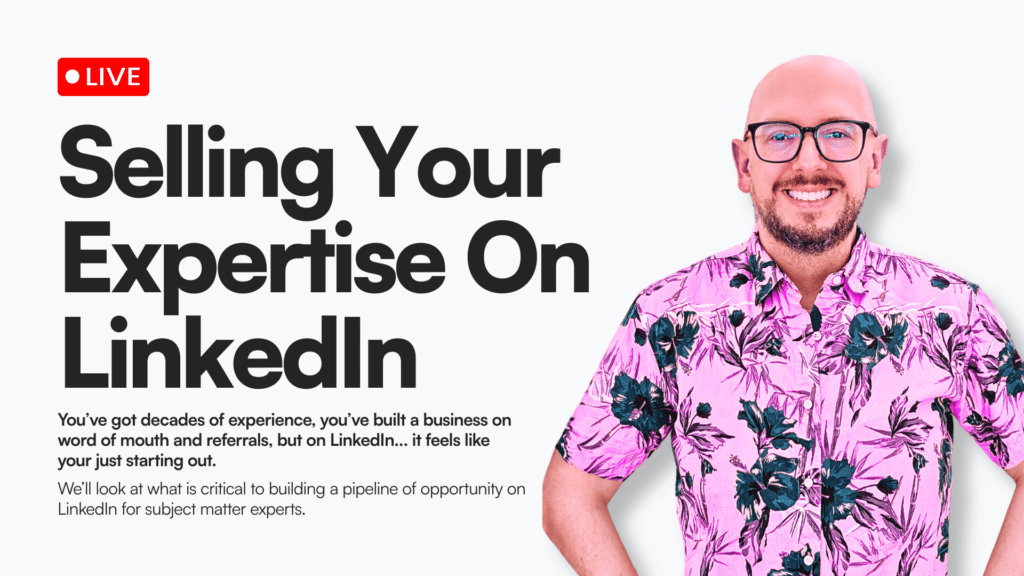
If you have spent years honing your skills, you already possess something valuable. However, many experts struggle to communicate that value effectively on social media. This session explores how to stop ‘having a go’ and start a deliberate process of LinkedIn authority building that converts expertise into revenue.
Most people who come to me have tried LinkedIn.
They’ve posted, they’ve messaged, they’ve had a go.
And it hasn’t worked the way they hoped.
This session is about why that happens and what to do instead.
No fluff, no promises of going viral. Just an honest look at what actually works and why.
Watch the recording of the LIVE webinar below.
Why you should build your expertise on LinkedIn
Word of mouth is great.
I love referrals. But you can’t build a business on them because you never know when they’re coming.
LinkedIn gives you something referrals can’t. A flow of leads you actually control. People choosing to work with you because they already trust you, before you’ve even spoken to them.
That’s the goal. Not going viral. Not chasing likes. Building trust at scale so that when the right person needs what you do, you’re already the name they think of.
Why Most Experts Fail at LinkedIn Authority Building
Here’s something most people teaching LinkedIn won’t tell you. LinkedIn isn’t the problem. Most of the time, the problem is a lot closer to home.
The referral trap
If most of your business has come from referrals, you’ve had an easy ride. I mean that genuinely, not as a dig.
With referrals, someone else does the selling for you. They vouch for you. They transfer their trust to you before you’ve said a word. On LinkedIn, that hasn’t happened. You have to build that trust yourself.
Most experts try to replicate the referral experience on LinkedIn without doing the upfront work. When it doesn’t convert the same way, they think LinkedIn doesn’t work.
It does work. You just haven’t built the trust yet.
The perspective trap
You see the root cause of your clients’ problems. They don’t. They’re trying to fix the symptoms they can see right in front of them.
Most people who struggle on LinkedIn have a message problem and a process problem. But they don’t know that. What they think they have is a lead generation problem. So they go looking for tactics.
If you go on LinkedIn talking about root cause issues, it goes over your audience’s heads. You have to lead with what they want and deliver what they actually need. Speak to the symptoms. Solve the root cause.
Trying too many things
The first thing you try on LinkedIn probably won’t work. That’s not a reason to quit. That’s just how it goes.
The mistake is trying something once, ditching it, trying something else, ditching that, and repeating until you’ve convinced yourself LinkedIn is useless.
Pick one approach. Stick with it long enough to figure out where it’s falling down. Fix that bit. Then do it again. That’s the whole process.
The “Five Ones” Framework for LinkedIn Authority Building
If you’re not getting results, the most likely reason is you’re trying to do too much at once. Too many services, too many audiences, too many messages. None of it lands.
The fix is what I call the Five Ones:
- One problem you solve
- One offer to solve it
- One audience who cares most about that problem
- One message built around that audience
- One process to convert them
I know that sounds limiting. It felt that way to me too. For years I didn’t want to be called the LinkedIn person. I knew email, events, sales strategy. But I couldn’t cut through saying all of that at once.
The moment I committed to one thing, the message got clear and the leads followed.
Get one thing working first. Expand later.
5 Paths to Scale Your LinkedIn Authority Building
There isn’t one way to get clients on LinkedIn.
What works depends on how you sell, what you sell and how you prefer to work. Here are the five paths I recommend.
LinkedIn newsletters
A newsletter lets you build an audience of people who’ve actively chosen to hear from you. It’s largely algorithm-proof, which matters because you’re not at the mercy of every change LinkedIn decides to make. I’ve got 31,000 subscribers to mine. If you’re more niche, 500 of the right people is worth more than that.
Conversion content
This isn’t about going viral. Viral posts get visibility. Conversion content gets leads. A post that does 1,400 impressions with the right message in front of the right people is worth more than one that does 100,000 impressions and brings in nothing. I know because I’ve got both on my profile right now.
Events and webinars
You’re watching me do one of these right now. I’ve been doing them for six years and 70% of the clients who’ve bought from me attended at least two of my events first. That tells you everything about what trust does for conversion. An event lets people hear you think in real time. That builds more trust than any post.
Relationship-led selling
This is a structured series of interactions that warms a relationship before you make any kind of ask. LinkedIn is a social platform. Doing the social bit first actually makes a difference. Not for everyone, but if you’re comfortable with one-to-one, this works well.
This path aligns perfectly with our social selling framework, which prioritizes connecting and building curiosity before you ever ask for a meeting.
Hyper-targeted prospecting
Not mass outreach. Not templates. A small number of highly personal, well-researched messages to exactly the right people. When everyone else is sending the same copy-paste message, being genuinely human stands out. The conversion rate on this done properly is far higher than anything volume-based.
Scaling Your Business Through Continuous LinkedIn Authority Building
Pick one of those paths.
Not the one that sounds most impressive. The one that actually fits how you work.
Then build a simple process around it. What are you doing, on which days, for how long. Most people don’t need more than 30 minutes a day. What they need is a clear plan so those 30 minutes actually compound into something.
Take the quiz and find your best path to pipeline
The people who get results on LinkedIn aren’t doing more. They’re doing the same things, consistently, over time.