

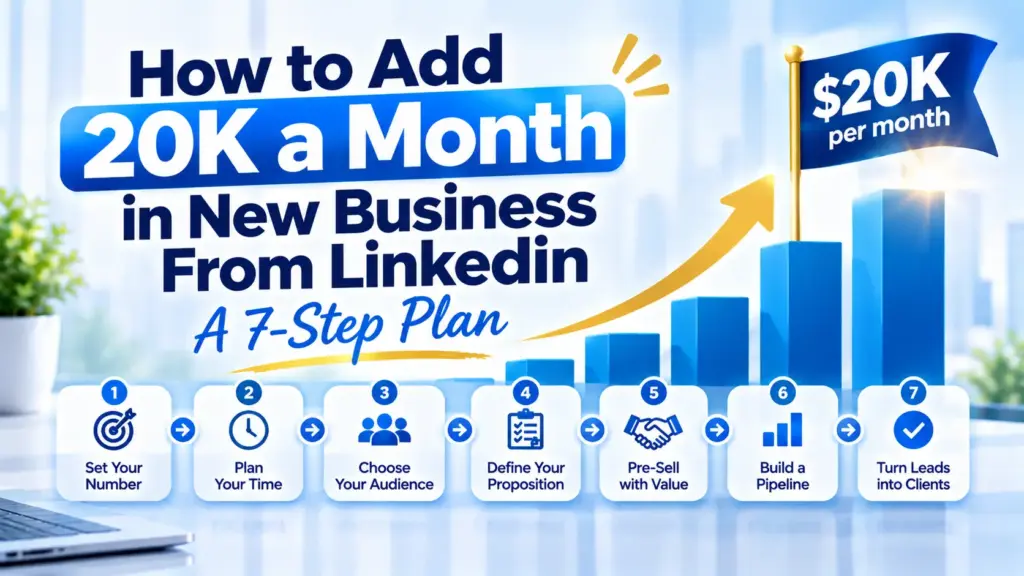
Getting an extra 20K a month in new business from LinkedIn is realistic, but not if you use LinkedIn the way it worked five or six years ago. Algorithms, crowded feeds and shorter attention spans mean you need a strategy that fits how the platform works now.
This article gives you a practical plan. You’ll start with the number you want and work backwards to how many clients, how many leads and how many hours it takes.
We’ll go through…
- Why you should work backwards from the number
- How to budget your time
- Why focus beats opportunity
- The seven questions that settle your proposition
- How to pre-sell before anyone enquires
- How to build a pipeline with one lead path
- How to follow through so leads become clients
So, let’s get into it.
Step 1: Work backwards to win new business from LinkedIn
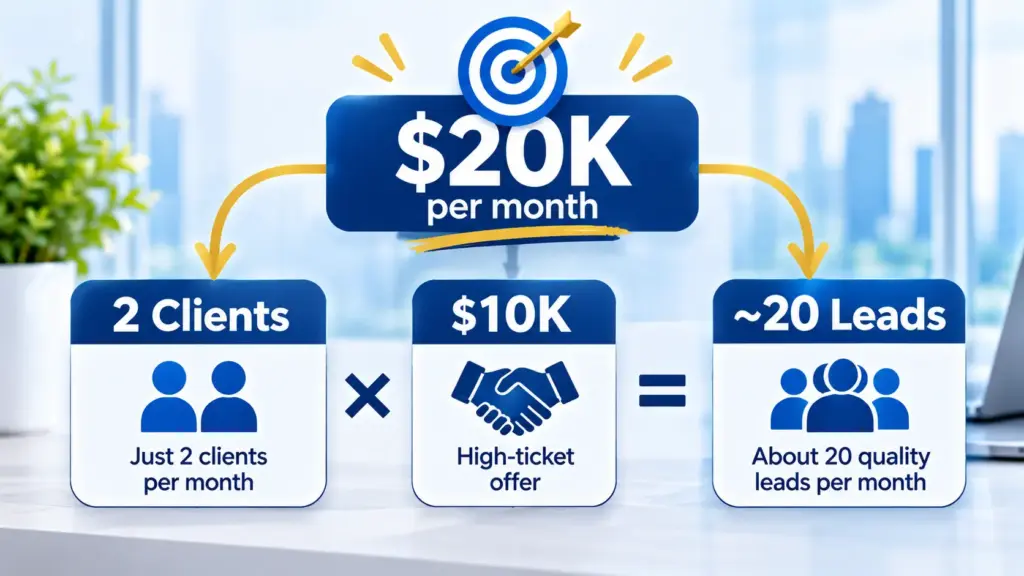
The first principle is to make 20K a month take as few clients as possible. That means selling something fairly expensive.
If your offer costs 10K, you need two clients. If it’s 20K, you need one. For two clients, you might need around 15 to 20 of the right leads in a month. That’s a goal you can plan for.
Now compare it with a low-ticket product. Selling a 20 book, or a 97 or 297 course, means you need huge reach to get enough buyers, and LinkedIn can’t guarantee that volume. Dean’s view is that LinkedIn isn’t a low-ticket platform. Low-priced subscriptions and products only work when you have large reach or a big marketing budget.
Selling cheap and planning to upsell later is also harder than it sounds. Moving someone from 200 to 5,000 is a big leap.
If you can’t guarantee volume, sell high-ticket to a buyer who has budget.
Step 2: Budget your time to win new business from LinkedIn
Say you need about 20 leads and can give LinkedIn one hour a day, five days a week. That’s roughly 20 hours a month, or about an hour per lead. It sounds like a lot, but how you use those hours decides the result.
Watch out for these common traps:
1. “I’ll do it if it works.” People say they’d put in two hours a day if LinkedIn gave them 20K. It works the other way round: you put the effort in first, and there is usually a gap before results show up, especially if you haven’t built your network or trust yet.
2. Wasting the hours. Refreshing your stats, editing one post for two hours, scrolling the feed, or chasing shiny objects such as another course you won’t implement.
3. Wanting instant gratification. Some people get leads quickly. Many don’t, so you need discipline to keep going without getting disillusioned.
Perfecting posts is a particularly poor use of time. Nobody can reliably tell in advance which post will land. Do the best you can, learn as you go, and aim for a couple of posts a week.
Step 3: Choose one audience and offer for new business from LinkedIn
If you can serve many industries, that opportunity becomes a distraction. Each industry has its own problems, language and sales process. A cybersecurity company may have junior salespeople feeding leads to senior ones, while a traditional manufacturer may have senior salespeople chasing big contracts themselves. The outcome they want, more leads and clients, is the same. The message that resonates isn’t.
Try to serve everyone and your time gets split, your messaging turns vague and your profile and content end up middle-of-the-road. It might be interesting, but not enough to tip anyone into becoming a lead.
What to do instead
1. Pick one audience to go after first.
2. Sell one thing. Not several services at once.
3. Remember how small the market can be. If you only need two clients a month and your market has 1,000 people in it, that’s enough.
This works through two mechanics: relevance (the more you speak to your buyer’s specific situation, the more attention you get) and familiarity (the more people recognise you, the more they trust you). Together they let you convert with a small audience, so you don’t need to pitch a thousand people to get one sale.
Step 4: Settle your proposition with seven questions
If you can’t say what problem you solve, you don’t have a proposition. You have a shiny object. People don’t only run away from problems either. They run towards a better outcome, so you need to define both.
Answer these seven questions. They build your offer and your message, which should be consistent across your profile and content:
1. Problem: What specific problem do you solve?
2. Promise: What better outcome do you deliver?
3. Persona: Who exactly is it for?
4. Process: What’s your method for getting them there?
5. Proof: Where’s the evidence that you’ve done it before?
6. Scope: What does the service include, and is it mapped out where people can read it?
7. Price: What does it cost?
Scope matters more than people think. If buyers can’t see what you do and what it involves, they find it harder to consider before a call, and the leads you get are lower quality. Settle these first, or your 20 hours go on posting, connecting and outreach that lands with nobody.
For a full walkthrough, read how to sell your expertise on LinkedIn.
Step 5: Pre-sell before anyone enquires
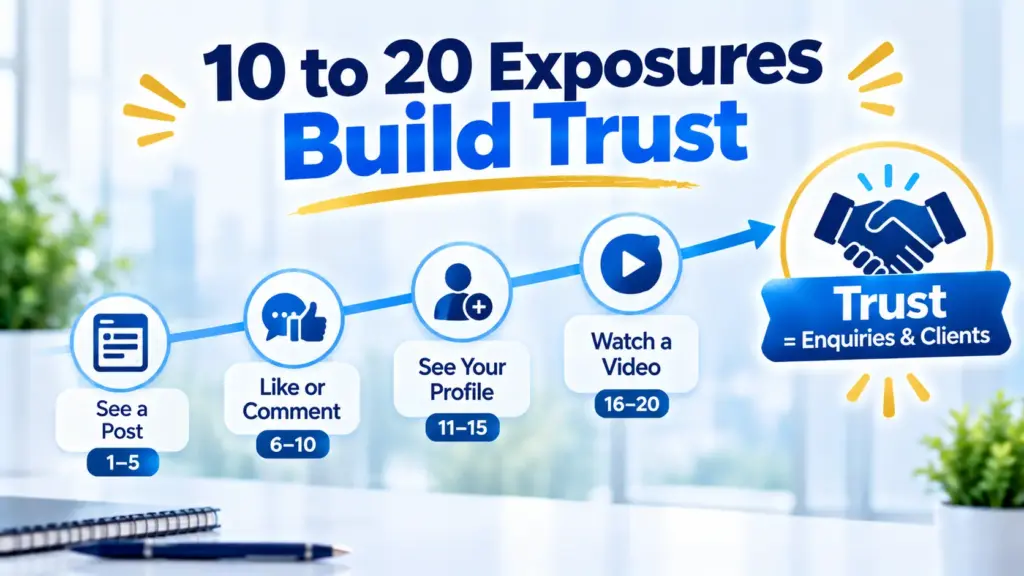
People don’t buy because of one post. They buy after a series of exposures, and the sweet spot is roughly 10 to 20, a pattern backed by LinkedIn’s B2B Institute research into how B2B buyers build brand familiarity long before entering an active buying cycle.
Search
If someone Googles you, is there enough to back up what you say on LinkedIn? Put proof where people and AI tools can find it.
Optimise your profile for new business from LinkedIn
Your profile is your biggest pre-selling asset, and most people waste it. Would a visitor understand your services and see your track record? Would the Featured section show testimonials, a resource or a way to learn about your service? Assume visitors know nothing about you. A vague banner or a line like “Join our November intake” with no context leaves people guessing.
Every post, connection, message and comment sends people to your profile, so it should answer their curiosity.
Your audience
Be honest: how many ideal clients are in your network? This isn’t about collecting connections for their own sake. It’s about being around as many potential buyers as possible, because some need to see you more often than others. Connecting with 20 of the right people a day, five days a week, with a 30% acceptance rate, would add about 30 relevant people a week. Some will become inbound leads, some will sit in your network for a long time first.
Your content
Share a couple of posts a week, and back what you say with stories and evidence from your real experience.
Step 6: Build a pipeline of new business from LinkedIn with one path
You only need one path to generate around 20 leads a month, so don’t try to do everything. Dean describes five. Two are particularly practical, and the approach throughout is reactive outbound: responding to someone else’s interest rather than cold pitching. If you’re uncomfortable with selling, that’s a good way to do it.
LinkedIn newsletters
Long-form content converts better than short-form. Short-form gets more distribution, so don’t confuse distribution with conversion. If you need two clients, you need a handful of the right people showing interest, not thousands.
1. Name it after what your buyer wants, not your company or a clever title. People subscribe mainly because of the name.
2. Check who subscribes and start conversations: “Thanks for signing up. How many clients would you want from social selling? I might have some ideas.”
3. Add a how-I-help section with a booking link in every edition.
Running live events to win new business from LinkedIn
Events aren’t magic. It’s people connecting with people, and you share value and build a connection over time. That’s especially useful when people need to buy into you before they buy from you. Afterwards, thank attendees, share the replay and some resources, and offer them a conversation.
The other three paths
1. Demand content: Posts and lead magnets that create tension and make people reach out. It’s the hardest path because you need enough reach and engagement.
2. Relationship-led selling: More outbound and more time-consuming, but effective for senior salespeople and small business owners. You don’t need many prospects.
3. Hyper-targeted video outreach: Very personal, relevant messages as short videos, low volume and high value. Dean reports about one meeting booked for every five he sends, so five a day is around half an hour of work.
If your proposition and persona are tight, those videos end up being very similar, which makes them quicker to produce.
Step 7: Master one path and follow through
Choose one path and get good at it until it becomes routine. If you keep changing and tweaking, nothing becomes a habit, and you won’t get good at the next stage either.
Many people lose leads in three places:
1. Getting the lead off LinkedIn: They rush it, and the lead loses interest.
2. The call: They talk about themselves instead of listening.
3. The proposal: It doesn’t create momentum or excitement, and the deal stalls.
Knowing what to do, having the message that makes it work, and actually doing it are three different problems. Most people who aren’t getting results have at least one of them. The first is training, the second is your proposition, and the third is behaviour and discipline.
The easy road, if you want one: launch a LinkedIn newsletter and run a LinkedIn event once a month. Stop tinkering and stop buying 97 quick hacks. A 97 course is unlikely to deliver the return you want.
Your 20K-a-month checklist for new business from LinkedIn
1. Offer: High-ticket, so two or three clients get you to the goal.
2. Leads: Around 20 of the right leads a month.
3. Time: A realistic hour a day, spent on the right things.
4. Focus: One audience and one offer.
5. Proposition: The seven questions answered.
6. Pre-selling: Search, profile, network and content all consistent.
7. Pipeline: One lead path, mastered.
8. Follow-through: A good conversation, call and proposal.
Want to go deeper? Explore our Social Selling Training or take a look at our free resources.
Keep reading: How to Get Leads on LinkedIn: The 3-Part System I Use Every Week
If you’d like help building your plan, book a call and we’ll help you map out a 90-day pipeline.